Summary
Bonhams will auction the "Hatfield" Apple-1, a rare working example of the first pre-assembled personal computerThe motherboard is signed by co-creator Steve Wozniak and the lot includes a 1978 letter signed by Steve JobsTraceable to its original owner with nearly all its components intact, it is one of only 74 verified surviving Apple-1 units
Bonhams is bringing one of computing's founding artifacts to the block with the "Hatfield" Apple-1, a still-functional example of the machine that launched Apple. The unit headlines the house's History of Science, Technology & Computing sale this October, distinguished by a rare combination of working condition, complete provenance and the marks of both Apple founders.
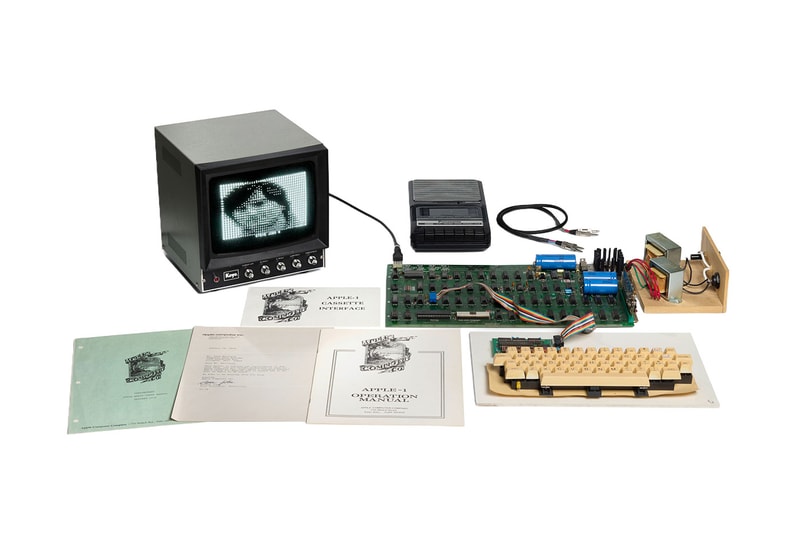
At the center of the lot is a second-batch Apple-1 motherboard, built in 1976 and preserved in running order. The board carries its original MOS Technology 6502 microprocessor, 8KB of RAM, keyboard interface, three Sprague "Big Blue" capacitors and its original cassette interface board, the setup that made the Apple-1 usable with a standard monitor at a time when rival microcomputers relied on banks of switches or slow teletype output. The sale bundles it with a deep set of period accessories, including the original operation and BASIC manuals, a 1977 Koyo video monitor, a Panasonic cassette recorder and two period keyboards.
What separates this example from the field is its paper trail. The motherboard is signed along its top edge by Steve Wozniak, who designed and hand-built the machine, and the lot is accompanied by a typed letter signed by Steve Jobs, dated January 18, 1978, offering original owner Fred Hatfield a trade-in toward an Apple II board. Hatfield, a Computer Data Systems employee who had written to Apple about the Apple-1's thin software library, ultimately declined and kept the computer. Because many owners who accepted the trade-in returned boards that were later parted out, an example traceable to its first owner with most of its components intact is exceptionally scarce. The unit last changed hands at auction in 2013, selling for roughly $686,000 USD, and now returns ranked No. 48 on the Apple-1 Registry as one of 74 verified survivors, fewer of them still operational
Wozniak conceived the design after joining the Homebrew Computer Club in 1975, and after he demonstrated it in early 1976, he and Jobs decided to commercialize the boards, formally founding Apple Computer Company on April 1, 1976. The company's first break came when Byte Shop owner Paul Terrell ordered 50 preassembled boards at $500 USD each, a purchase order Jobs leveraged into the parts credit needed to begin production. Only around 200 Apple-1 computers were ever made, with roughly 175 sold through 1977. Jobs later framed that era as a creative pursuit as much as a technical one, telling biographer Walter Isaacson, "I think great artists and great engineers are similar, in that they both have a desire to express themselves."
The History of Science, Technology & Computing sale runs online through Bonhams' New York saleroom from October 4 to 14, with the "Hatfield" Apple-1 carrying an estimate of $500,000 USD to $800,000 USD.