Key Takeaways:
- Personnel safety is paramount as voltages rise and incidents of electrical faults, arc flashes, and thermal runaways grow.
- Hot-swap circuits, solid-state circuit breakers, and other protection components help keep people safe while managing higher currents.
- Data centers are borrowing chip reliability technology from automotive, but 800VDC standards and protocols are not yet well defined.
Demand for power in modern data centers shows no sign of stopping, as it supports an expanding range of AI tasks across society. Racks are approaching 1 megawatt each, highlighting the need for more efficient power delivery from the source to the chip. One potential solution is replacing the conventional 48V DC in-rack power distribution systems with 800V DC.
Moving to a higher voltage brings many benefits. “800V has fewer power stages, less loss, a more efficient overall architecture, and the wide bandgap type of technology is a huge benefit when it comes to these data centers,” said Steven Lee, product manager, power electronics design software at Keysight Technologies. “They’re going to use the best semiconductor material they can because the loss is lower in those materials and the thermal tolerance is also higher. GaN doesn’t break down under higher temperatures compared to traditional silicon.”
However, safety and reliability challenges increase at higher voltages, especially when workers hot-swap server trays to avoid downtime. “In a data center with racks in full operation, when you need to change a part of a motherboard, the last thing you want to do is disrupt the operation,” said Adam White, division president of power and sensor systems at Infineon. “You want to make sure whoever is pulling out that motherboard is not going to be put into danger. That becomes even more critical moving forward, as the voltage stroke current goes through the roof.”
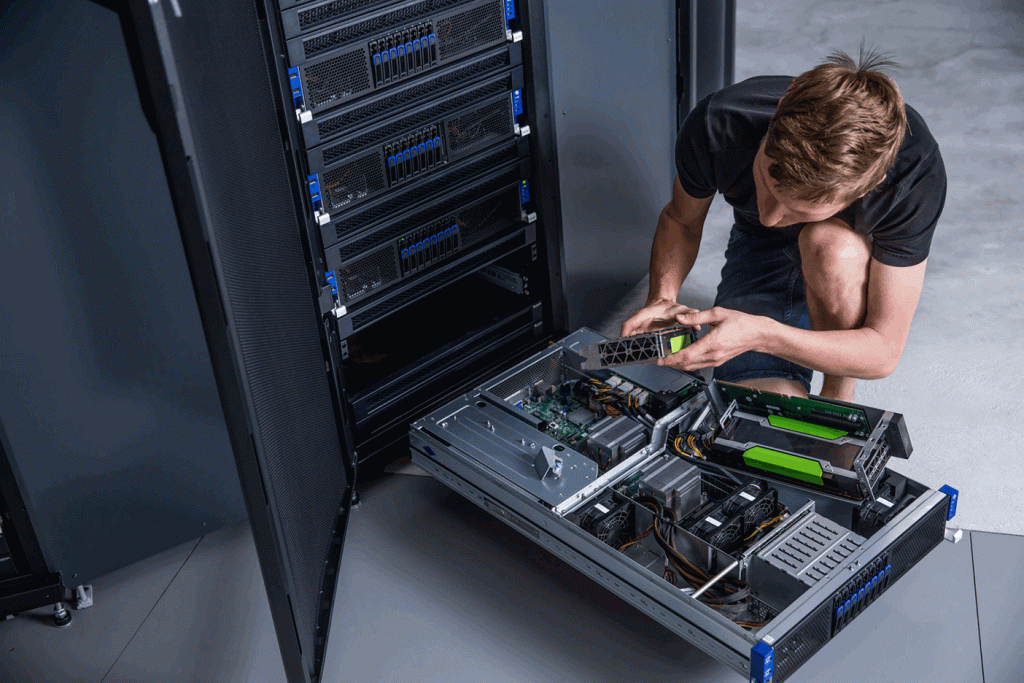
Fig. 1: Hot swapping data center server trays. Source: Infineon
48V is very different from 800V. “Higher voltage is a lot more dangerous. I don’t think 48V will kill somebody, but I think 800V will,” said Lee. “The way they want to design data centers is that if a certain section goes offline, they want to be able to hot-swap and power up something else to meet that demand. It’s the same way the grid works. If part of the grid is out, they want to allocate power from another part of the grid so that customers have power. With 800V, when you hot-swap and it’s not done the right way, you could get power arcs that could make a very loud pop, then a spark, and then something may blow up or fry, so there are definitely safety issues to working with high voltages.”
Isolation and protective mechanisms, such as hot-swap circuits, become crucial. “When you need to take out a tray, then put it back in, the hot-swap circuit enables you to protect, safely remove, and introduce trays for maintenance purposes,” said Pradeep Shenoy, compute power technologist at Texas Instruments. “When you get to the higher voltages, you need to keep that in mind. It isn’t present in something like an EV. It’s unique to the data center. The challenge is how to move from 48V to 800V in a safe manner.”
Architecting and designing with safety in mind means engineers must keep a minimum safe distance between the high-voltage system and the low-voltage system, which is a consideration for the overall data center design.
Systems are also more complex as voltages get higher. “This includes current sensing to detect what’s going on,” said Peter Wawer, division president of green industrial power at Infineon. “You need to program the tripping. The electromechanical variants have a lot of variety. In semiconductors, you can do customization via software. That feature will simplify the whole supply chain in the future, and more costly solutions might become competitive sooner because the amount of variance you have to have in your stock to fulfill the different requirements can simply be programmed.”
A Siemens white paper says 800VDC offers simpler construction, improved conversion efficiency, reduced reactive power, and flexible integration of backup power and other energy sources. But DC power distribution has challenges related to power conversion and delivery, electromagnetic compatibility, and metering. This is capacitive in nature, with capacitors throughout the network connected to DC voltage and storing necessary operating energy. When faults occur, the capacitors release stored energy, greatly increasing fault current and disrupting DC voltage, which creates safety risks and system downtime.
Therefore, protecting DC distribution for data centers must consider wiring and grounding, protection devices, coordination, arc-flash mitigation, and ground-fault protection.
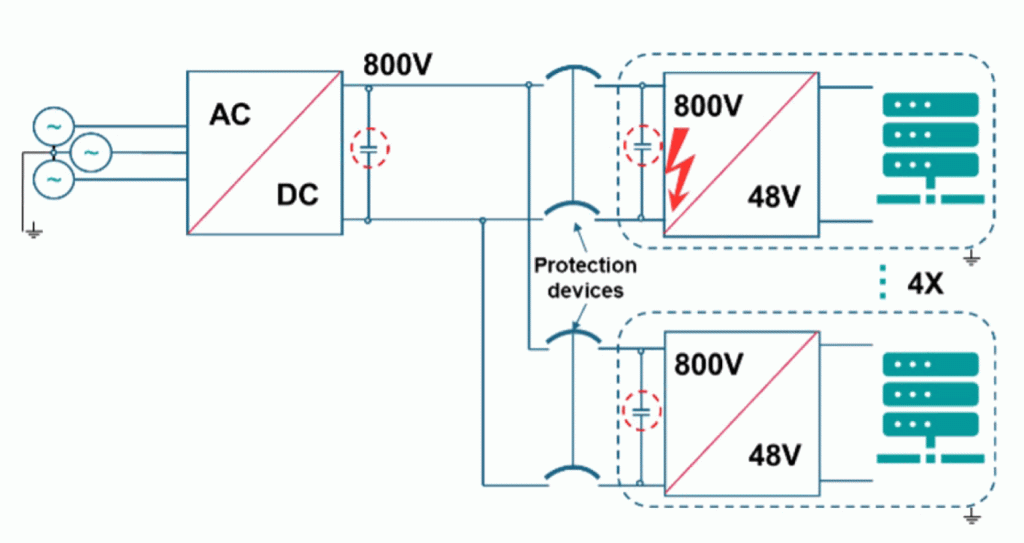
Fig. 2: Simplified 1 MW floating 800VDC block with one source and four loads. Source: Siemens
Protection components
When it comes to protection components, solid-state circuit breakers (SSCBs) offer several advantages over mechanical circuit breakers, including sub-millisecond fault protection, zero arcing, a much longer lifespan, and seamless integration with smart IoT prediction and alert systems.
Mechanical switches worked fine before because AC switches direction and hits 0 many times a second. Every time it hits 0, any spark will naturally go out. But DC flows in one steady direction and doesn’t necessarily cross 0 volts. If a mechanical switch is opened on a live DC circuit, the electricity keeps jumping across the gap in the air. This creates a continuous, hot arc that can melt the switch or start a fire. An SSCB can turn the current off electronically in microseconds, without a physical separating gap, so a sustained arc never gets the chance to form.
“Traditional mechanical switches react in milliseconds, so they’re just not that fast,” said Keysight’s Lee. “On the other hand, DC works pretty fast, especially 800V. It doesn’t necessarily cross zero volts, but a solid-state switch or circuit breaker can detect the arc and shut down or open much faster than a mechanical one. That could prevent the hazard from happening, which is the big motivation behind these solid-state circuit breakers.”
Further, SSCBs rely on physics for detection. “If it detects a short, it closes, then it will open,” said Lee. “It’s not more intelligent, but it’s much faster. It’s all physics. There’s no controller or ML chip behind it. It just knows that it should see a certain voltage, but once it detects zero volts, which means something’s wrong, it’s just going to pop open the entire thing. It’s all materials.”
Others agree SSCBs are better for 800VDC architectures than electromechanical relays or mechanical breakers. “They were very reliable and have the advantage of being quite cheap, but they are slow,” said Infineon’s Wawer. “If a fault appears, there’s a high risk that you simply damage the gear they should be protecting. Semiconductor-based circuit breakers increase the speed of protection by orders of magnitude.”
Circuit breakers are an essential part of the electrical system and cover a wide range of voltages, from a single 63-amp MCB motor-based circuit breaker to thousands of amps. “Every building has a room in the basement full of circuit breakers to protect the building and protect the feed,” said Wawer. “The mechanical experts and electrical technical experts can then switch thousands of amps. The market stretches from a single discrete device, in the range of 70 to 150, maybe 1,000 or more breakdown voltage, up to much higher voltages and higher current ratings.”
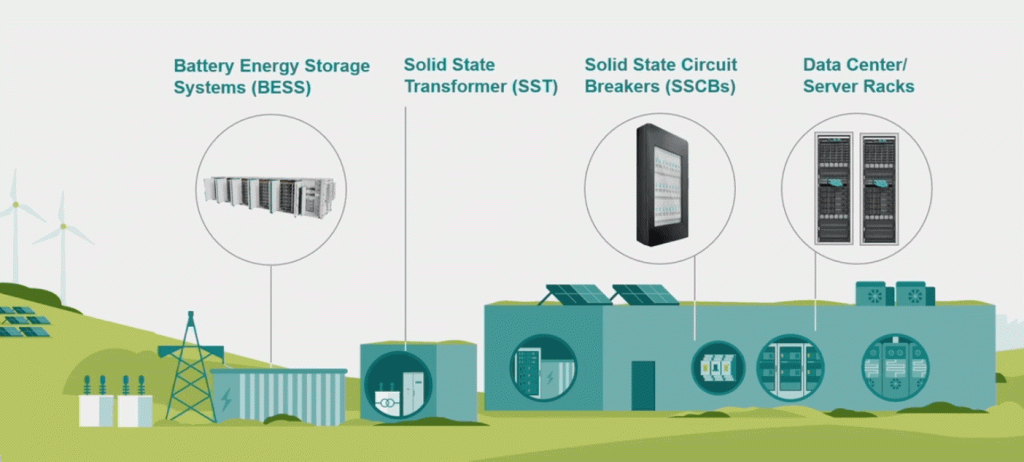 Fig. 3: Data center power management. Source: Infineon
Another option is a solid-state hybrid circuit breaker (SSHCB), which uses a metal contact system for ON-state conduction, like mechanical circuit breakers, but also power electronics for interruption, similar to SSCBs, according to Siemens. Electronic fuses (e-fuses) are intelligent, solid-state overcurrent protectors that are similar to SSCBs, but without the integral air gap. As a result, e-fuses cannot be considered branch circuit protection.
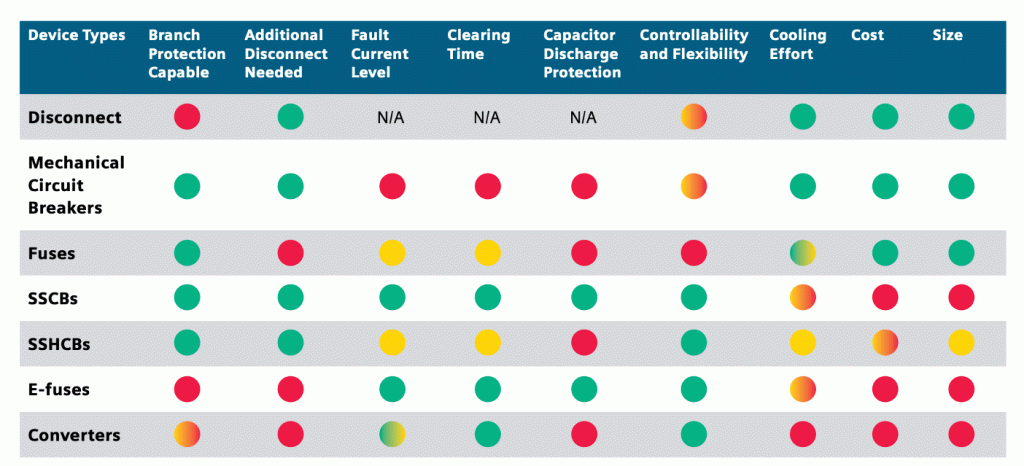
Fig. 4: Table 2. Qualitative comparison of protection devices. Source: Siemens
SSCBs also can prevent battery disconnects in vehicles. “Today, for cost reasons, typically, battery protection is a pyro fuse in the car,” Infineon’s Wawer noted. “The problem is, if it blows up, you have to bring your car to the garage to fix it. The solid-state circuit breaker provides non-destructive protection. It doesn’t destroy the fuse.”
Thermal considerations
Sudden sparks are dangerous, but a more prevalent challenge in the data center is heat throughout the system. “The number of GPUs running simultaneously and the rate at which they generate heat demand a more comprehensive and proactive approach to planning and operations,” said Hoa Tram, senior principal product engineer at Cadence. “Traditional methods such as triggering alerts based on temperature threshold crossings, while still necessary, must be supplemented with technologies like digital twins that can simulate thermal conditions across an AI data center minutes or hours ahead. This not only enables more efficient orchestration of workloads across GPU clusters, but gives operators and cooling systems valuable additional time to prevent or limit thermal damage. And that damage can develop far more rapidly in high-density GPU environments than in traditionally architected data centers.”
The ability to predict is essential. “When you have these high-power, high-current types of converters, things heat up, and the big questions are how to simulate and predict the kind of heat that it’s going to generate, and how to design a cooling system that can dissipate all that heat so easily,” said Keysight’s Lee. “A lot of boards have huge heat sinks on top of them that can dissipate heat from the MOSFETs. But big data centers have a much more sophisticated type of thermal dissipation, with liquid coolants running through all the racks. In order to do that, you have to understand the boundary conditions. What’s the worst-case scenario in terms of heat that I have to be able to dissipate? If you don’t predict that accurately, things will heat up, and then things will blow up and not work, and you have downtime.”
Data center, automotive reliability needs and standards
Concerns over efficiency and reliability have led to an exchange of technologies and innovations between automotive and data centers, as well as a migration of some standards from safety-critical to mission-critical.
“Automotive is one of our base markets that we’ve done for decades, and the data center is kind of new for us,” said Kristof Beets, vice president of product management at Imagination Technologies. “But what we found is that a lot of the reliability mechanisms that we put in for the ASIL B or even ASIL D requirements were very useful for the reliability in the data center. That’s because if you’re using something, but you don’t realize it’s broken, you’re wasting an enormous amount of processing and time. The faster you can detect a failure, the better, and very often those are hard failures. Those are hot environments, with lots of radiation, lots of stuff going on. Chips will just fail, and that’s why we’ve been building in low-cost continuous self-testing in the hardware.”
For automotive, there is a 100-millisecond window to figure out if something has gone wrong and then report it. “That’s unheard of in the data centers today,” said Beets. “They are running massive layers, huge parts of their network, and very often when they try to execute, that’s the point where they then figure out, ‘Well, one of our many GPUs went wrong. Now we need to roll back and figure out where it went wrong, and where we got the dodgy data.’ We can do that very, very quickly, and that’s gaining a lot of interest from our data center customers, in terms of whether we can detect it. Then the rollback window is much smaller. Also, because we are detecting not just if there is a fault, which is kind of all we need to do in automotive, but we can also know where the fault occurred, you can then take that unit offline and keep most of your GPU. So you don’t have to run over there, pull the racks out, and put a new one in. We can just disable that one processing unit that has failed. But then, of course, that silicon is then less trusted, so at a sensible point in time you would still want to do a physical replacement of it. But we could have that continuing to run much, much quicker and with less cost overhead.”
Additionally, data centers’ reliability needs are still growing. “I would suggest that the reliability requirements are higher in data centers than in automobiles,” Cadence’s Tram noted. “With automobiles, systems are designed to be isolated and to operate independently from one another to the extent that it’s possible, and the scale of power involved is just tiny compared to an AI factory that needs to synchronize the work of massive numbers of energy-intensive GPUs. A starter motor, by design, is not supposed to care what the headlights are doing. Automotive loads are event-driven and human-initiated — or road-condition-initiated — not algorithmically synchronized across a cluster.”
In a large AI training cluster, hundreds of thousands of GPUs are tightly synchronized and can all hit peak compute simultaneously during matrix operations and drop simultaneously during synchronization and checkpoints. “The transient isn’t one load spiking. It’s an entire correlated fleet spiking in lockstep,” Tram explained. “This transforms a local power quality problem into a potential grid-destabilizing event — something no automotive electrical engineer has ever had to consider. A car’s battery never has to worry that its transient absorption behavior could cause a regional blackout that disrupts or even endangers the lives of hundreds of thousands, perhaps millions, of people. The potential ‘blast radius’ of a catastrophic failure of the power systems of an AI factory is also one of the compelling reasons for these data centers to adopt the latest monitoring and simulation technologies, including digital twins.”
Across all data centers, both greenfield and brownfield, a major complicating factor is that standards for 800VDC safety are not yet fully developed. “NFPA 70E, for example, covers DC systems in principle, but its arc flash calculation methods were developed primarily around AC systems and are known to be less accurate for DC,” Tram said. “IEC 61439 and UL 508A cover DC switchgear and control panels, but not specifically at 800V data center scale. OSHA regulations reference NFPA 70E for electrical safety but don’t address 800VDC data center architectures explicitly.”
The differences between automotive and data centers come down to manufacturer qualification. “For example, automotive OEMs comply with standards such as AEC-Q100, and some parts need to operate as high as 175°C,” said Infineon’s Pawloski. “Data centers traditionally would use industrial standards, which are not the same as automotive. But data centers are starting to change those qualification requirements to the point where they’re being even more difficult than the auto requirements, because you want super high reliability. You don’t want a power supply to go down and take down a large server.”
Power converters — such as transformers and power distribution mechanisms, including bus bars — should adequately support the fluctuating loads on AI data centers. “The main challenge for these components is to operate efficiently and reduce electrical losses,” said Pavani Gottipati, director of applications engineering at Synopsys. “The harmonics in AI power loads may result in localized AC losses and hot spots that can cause these components to fail, resulting in the downtime of a rack and adversely impacting the data center operations, or worse yet, causing an outage to the data center customer. Advanced multi-physics optimization tools can help design electrically and thermally robust power conversion and power distribution mechanisms for AI data centers.”
Chip packaging must also be considered. “As power-dense chips provide improved compute performance for AI data centers, reliable operations of data centers would also require that the electrical architecture around chips can support the increased power densities,” Gottipati noted. “At the chip and packaging level, this would imply using magnetic materials in packaging to boost power densities. However, chip designers need to ensure that these magnetic materials do not cause EMI (electromagnetic interference) when integrated onto the boards.”
That same reliability challenge extends beyond power delivery and packaging to the components that must remain serviceable inside increasingly dense, liquid-cooled AI racks.
Memory and serviceability in liquid-cooled AI racks
High-performance AI servers in modern data centers require availability, manageability, serviceability, and reliability — and this includes memory. “As AI infrastructure scales, data center operators need memory solutions that deliver not only performance and power efficiency, but also the reliability and serviceability required for continuous operation,” said John Eble, vice president of product marketing for memory interface chips at Rambus. “For example, SOCAMM2 has a modular LPDDR-based memory architecture that enables upgradability, field replacement, and lifecycle flexibility in a form factor suitable for liquid-cooled designs, while a SOCAMM2 chipset provides the telemetry, configuration, and localized power management needed for reliable operation at scale.”
Further, the liquid cooling systems themselves must be tested for reliability.
“There are a lot of pumps and motor drives that go into all of these systems, and you have liquid that needs to get pumped through,” said TI’s Shenoy. “Heat exchangers and the like create some new challenges, such as leak detection. Previously, we didn’t have liquid going through these systems. Not all that long ago, you just blew air over them. Now that there can be liquid cooling, you need to keep the temperature of all these devices at a certain level; otherwise, they will exceed their ratings and get damaged.”
Thermal cycling can be tested through board-level reliability (BLR). “We do temperature cycling, where we intentionally stress the device up to a high temperature, then bring it to a low temperature,” said Shenoy.
While temperature is more regulated in a data center than in a vehicle, thermal cycling can negatively affect both environments. “Thermal cycling is a big killer for electronics, going from cold temperatures to hot temperatures and cycling back and forth,” said Jim Pawloski, director of applications engineering at Infineon. “That can weaken interconnects within the die itself, or between the die and the attachments to the die. In qualification and test, you might need to verify that a part can handle so many switching cycles, and that could be more severe in data centers than it is currently for automotive.”
However, automotive operates at higher overall temperatures. “Given that data centers are stationary installations, they do not experience the wide or rapid fluctuations in electrical loads that characterize EV or hybrid‑vehicle operation,” said Bryan Kelly, principal engineer at Synopsys. “They also operate within tightly controlled and optimally maintained environmental conditions.”
Conclusion
Moving to 800VDC offers greater efficiency for AI data centers, but also brings higher safety risks, including electrical shocks, arc-flash events, battery thermal runaway, and challenges in equipment isolation. Safety and protection measures are therefore needed at every step of the power distribution system, from the grid or an alternate power source to high-density AI racks, which are moving to over 1 MW each.
Chip reliability is also part of the 800VDC safety equation because fewer intermediate power conversion steps bring high-voltage power within inches of the processors. Overall, the risks are likely worth the power savings and efficiency gains as AI continues to find new use cases.
Related Articles
800VDC Pushes AI Power Design From Grid To Gate
The next power bottleneck is no longer just inside the accelerator — it is the full conversion path from medium-voltage AC to sub-1V silicon.
The 1-Megawatt Rack Debate
Is it better to cram more compute into each rack or rethink the architecture?
Chip Innovation Will Bridge The Gap For USA Data Center Power
GenAI demand is exponential; the US power grid can’t keep up; necessity spurs invention.
AI Data Centers And Auto Industry Converge On Same Issues
The EV revolution relies on battery innovation, while AI data centers need a range of new energy solutions to play nice with the grid. Both sectors are taking notes.
The post What Can Go Wrong In 800VDC AI Data Centers appeared first on Semiconductor Engineering.