FSP is not a brand that needs an introduction so much as a reminder of scale. Founded in Taiwan in April 1993 as a joint venture between Fortron/Source of the United States, Sparkle Power International, and Powertech Systems — the three names that give the company its initials — FSP grew into one of the largest power-supply manufacturers in the world. It became one of Intel’s early seed partners during the formative years of the ATX standard, was listed on the Taiwan Stock Exchange in 2002, and has spent three decades quietly building units for a long list of system integrators and consumer brands. When most companies want a power supply, they call an OEM. FSP is the company that frequently gets the call.
That distinction matters here. The Mega GM is not a contracted design wearing someone else’s sticker but FSP’s own platform, engineered and assembled under its roof. We evaluate the Mega GM 1200W to see whether it belongs on our best power supplies list. The series spans 850W, 1000W, and the 1200W flagship reviewed here, all built around the same ATX 3.1 and PCIe 5.1 brief: native 12V-2x6 delivery, support for the 200% transient power excursions modern GPUs demand, and FSP’s proprietary MTLC (Micro Tolerance Load Control) regulation scheme. On paper, it is positioned as a Gold-class product. In practice, as the testing will show, it behaves like something a tier above.
Specifications and Design
RAIL | +3.3V | +5V | +12V | +5Vsb | -12V |
|---|---|---|---|---|---|
MAX OUTPUT | 20A | 20A | 100A | 3A | 0.3A |
100W | 100W | 1200W | 15W | 3.6W | |
TOTAL | 1200W | ||||
AC INPUT | 100 – 240 VAC, 50 – 60 Hz | ||||
MSRP | $229 | ||||
WARRANTY | 10 Years |
In the Box
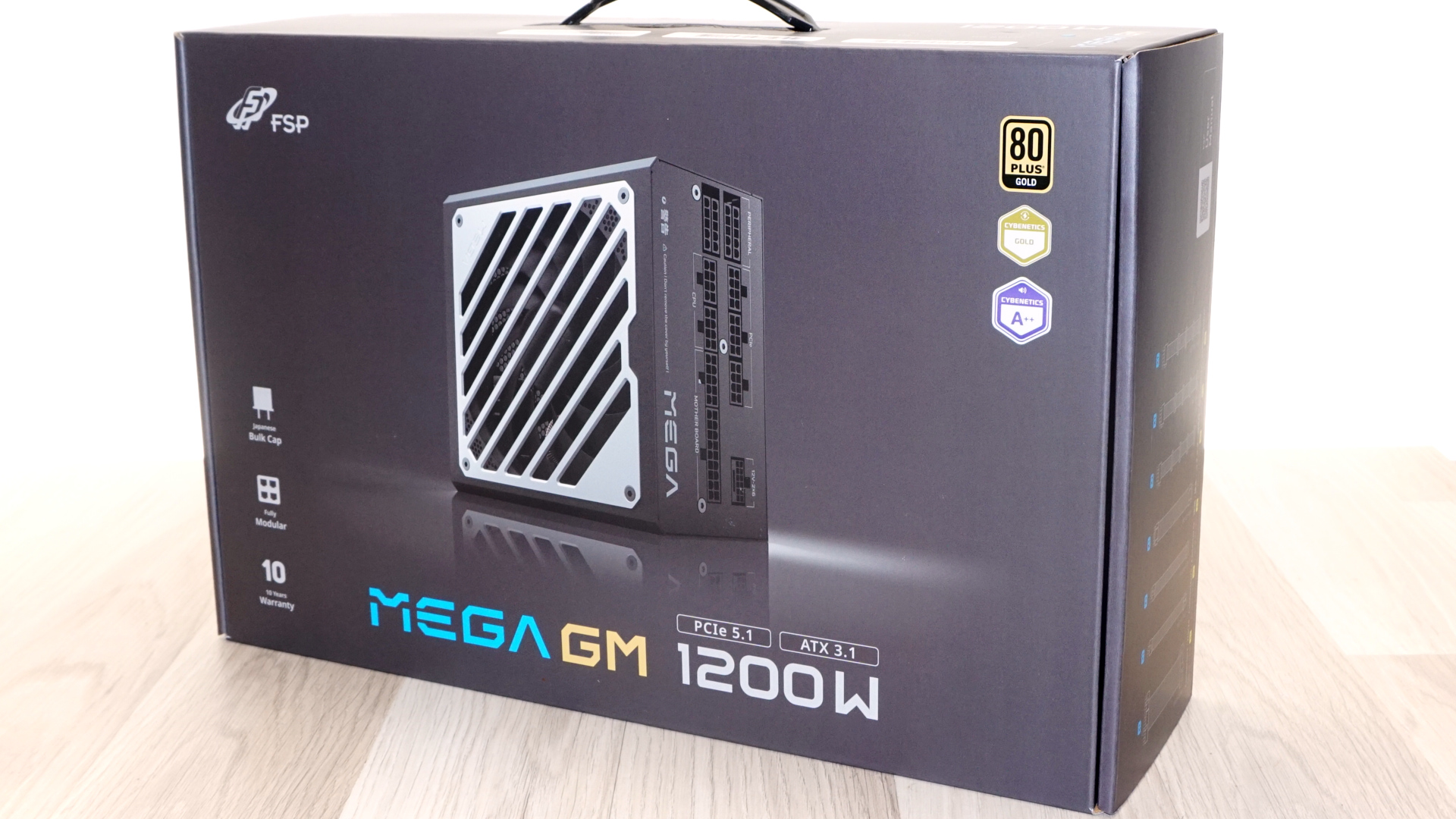
The Mega GM 1200W arrives in a cleanly designed box, black with a high-resolution render of the unit and the certifications laid out plainly on the front: 80 PLUS Gold, Cybenetics Gold, and the Cybenetics A++ acoustic award, alongside the PCIe 5.1 and ATX 3.1 badges – which is kind of weird considering the unit’s actual certifications are not aligned with those on the box!
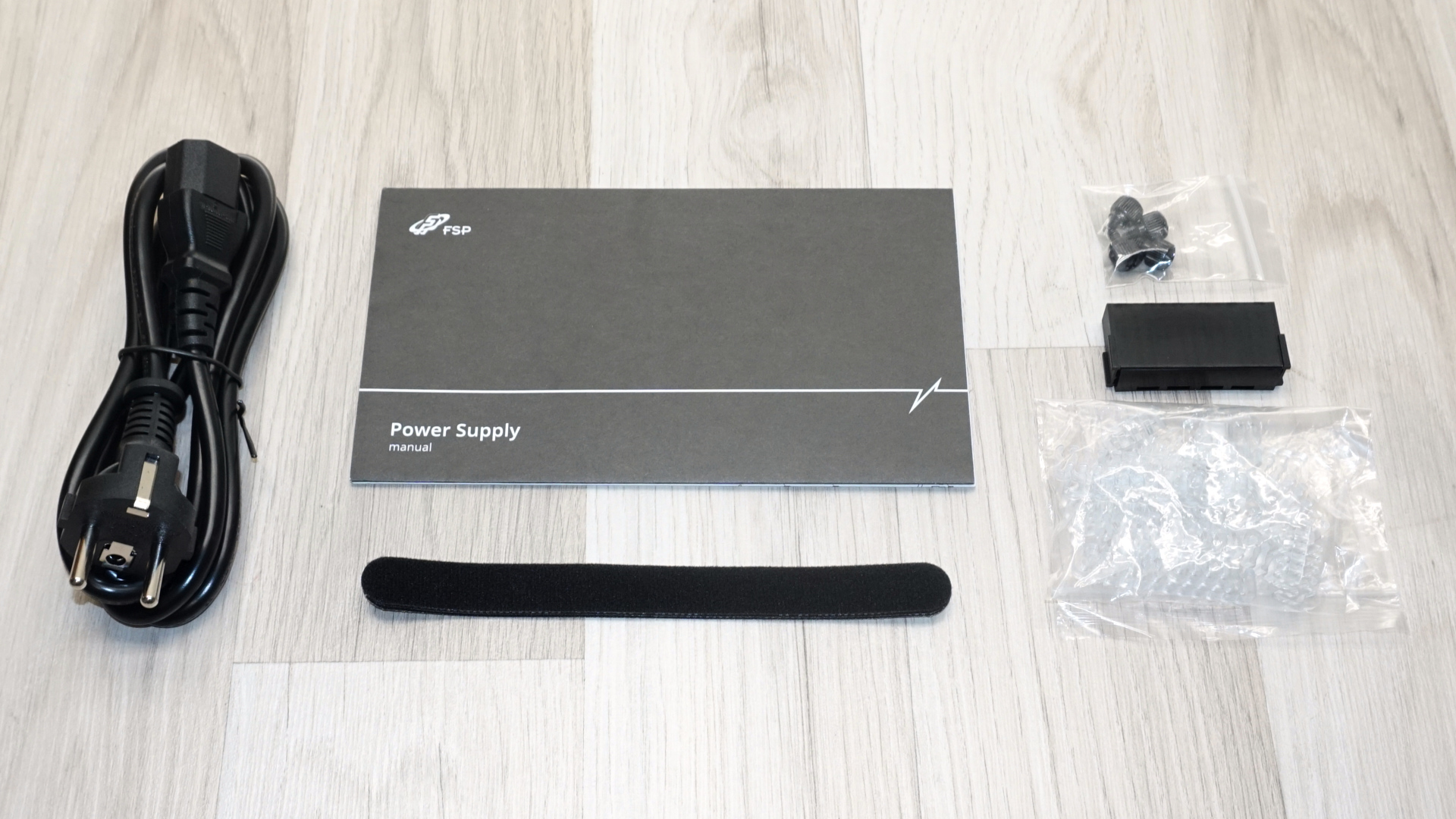
Inside, the supply is well protected within a molded cardboard housing, with the accessories boxed separately. The bundle is sensible, if not lavish: mounting screws, the AC power cable, cable ties, a set of cable combs, an ATX jump-start tester, the usual paperwork, and a storage pouch for whatever cables a given build leaves unused.
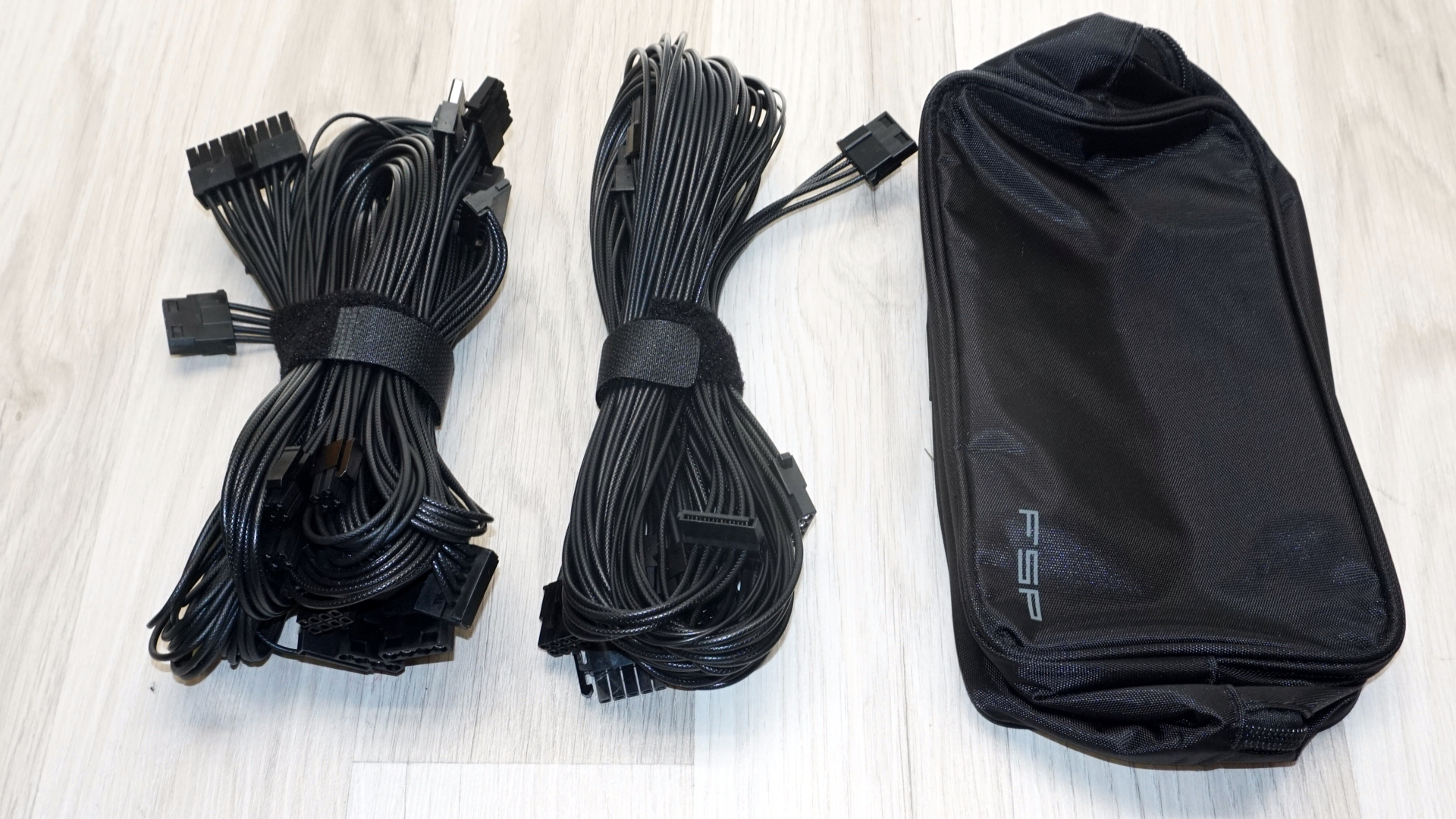
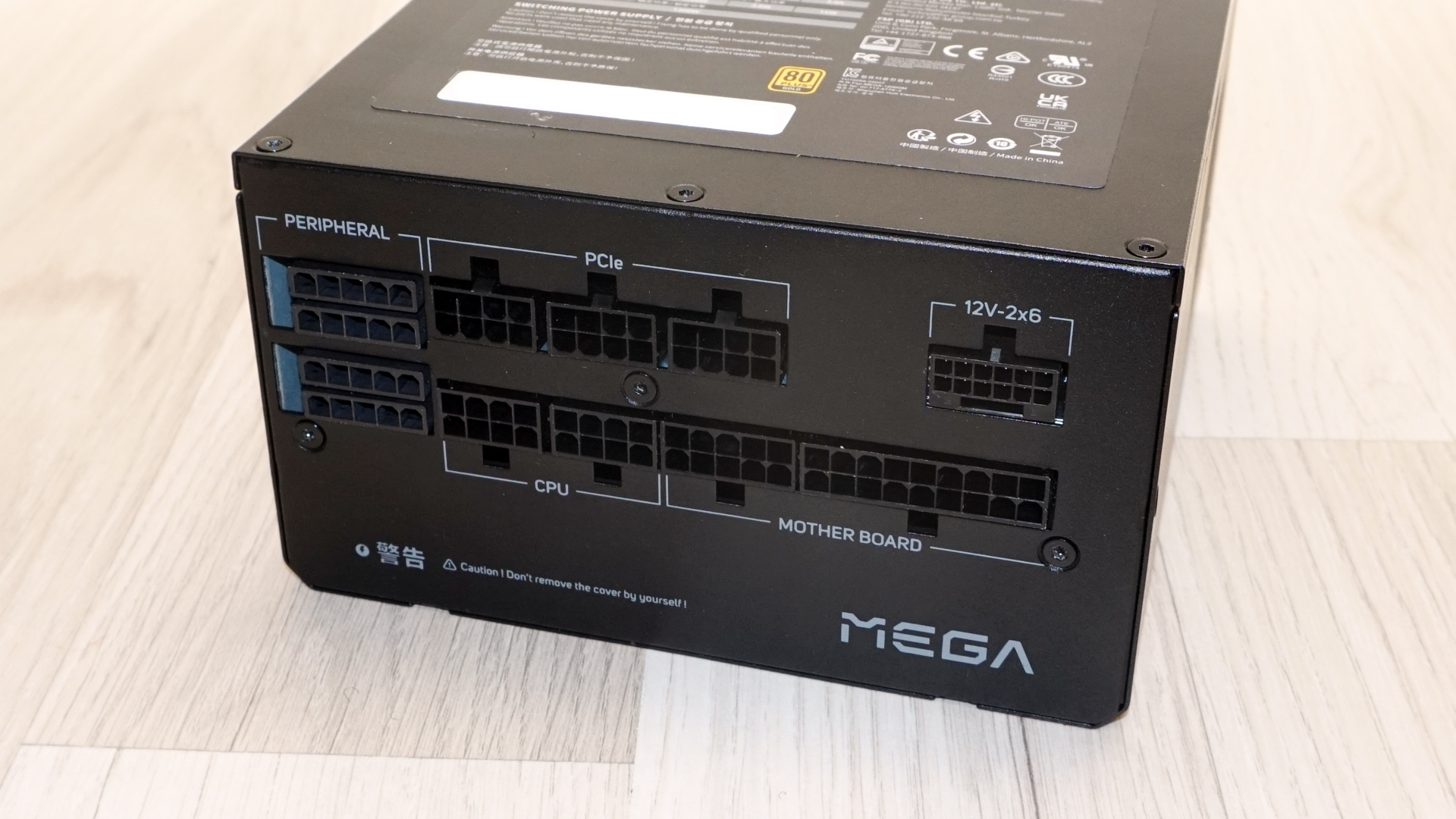
The cables themselves are individually sleeved with FSP’s embossed weave and shipped in two tidy bundles held together by another two reusable cable straps. Gauges are appropriate to the tier. That native 12V-2x6 lead is the headline inclusion - a full 600W with no adapters, which is exactly what an RTX 50-series build wants to see. Sadly, there is only one, which is a shame for a 1200W unit.
Connector type | Hardwired | Modular |
ATX 24 Pin | - | 1 |
EPS 4+4 Pin (CPU) | - | 2 |
PCI-E 5.1 (12V-2x6) | - | 1 |
PCI-E 8 Pin (6+2) | - | 3 |
SATA | - | 10 |
Molex | - | 6 |
Floppy | - | - |
External Appearance
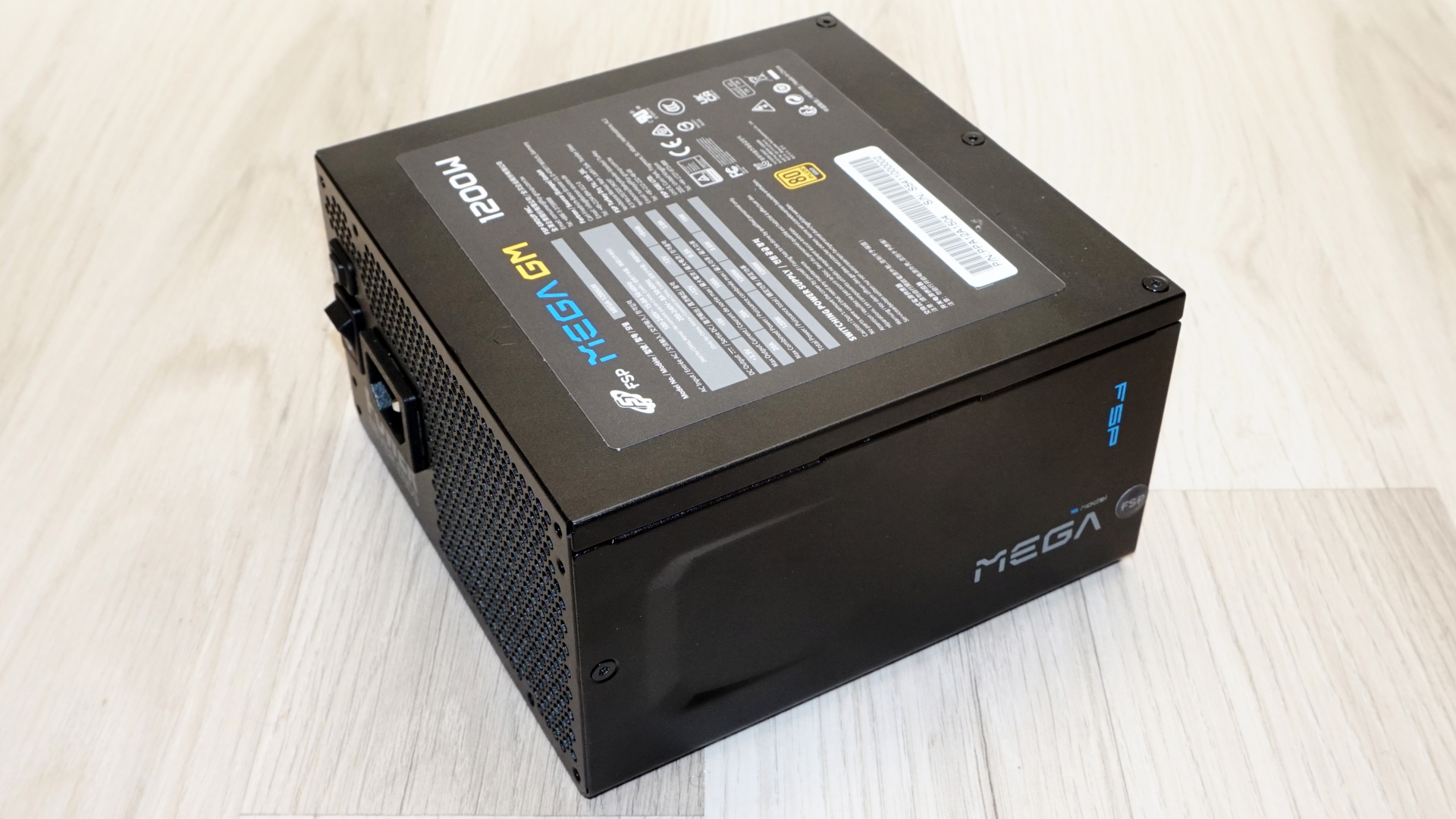
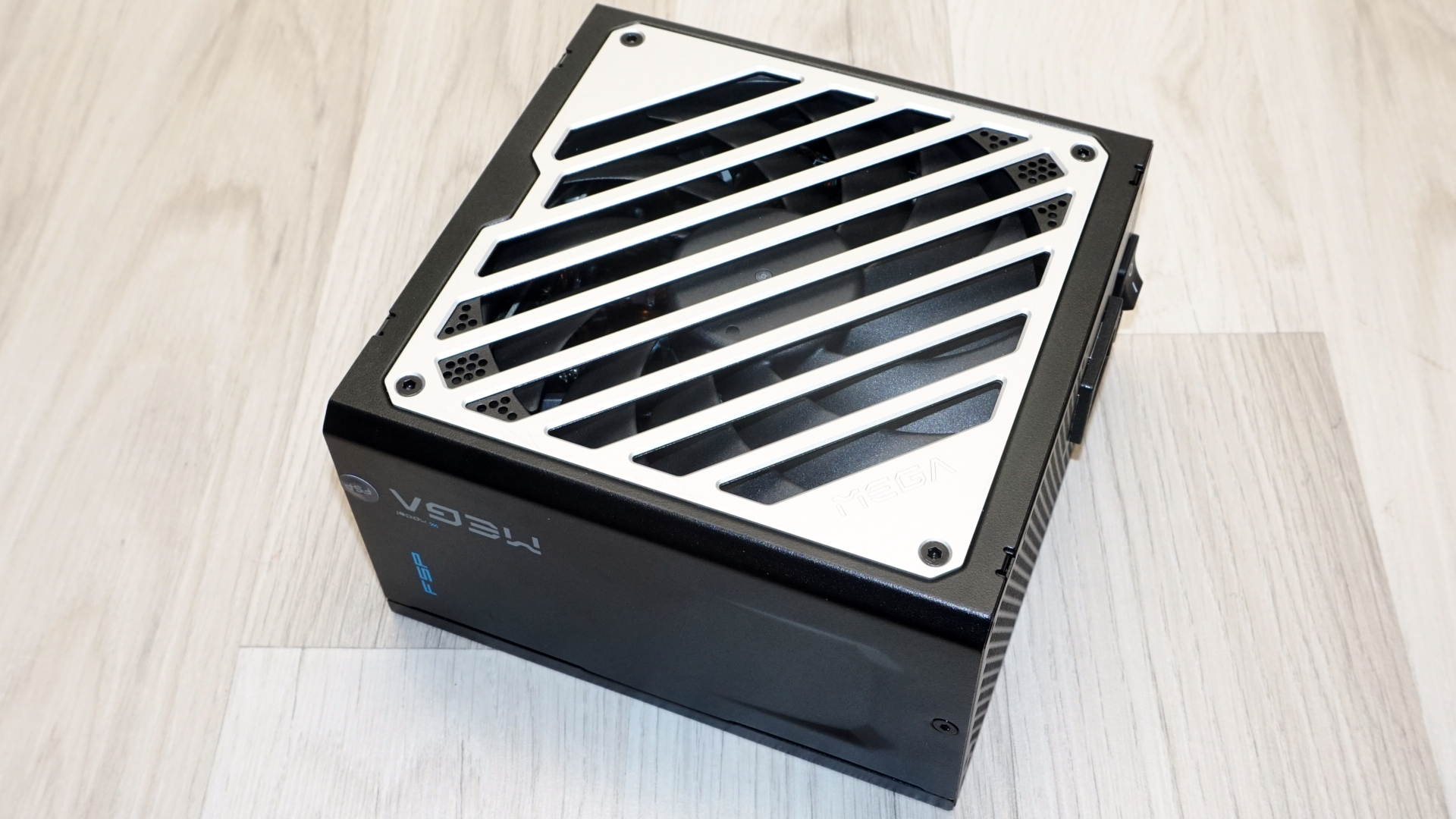
At 150 x 150 x 86 mm, the Mega GM 1200W is genuinely compact for its output. A great many 1200W units stretch to 160 mm or beyond, so the standard 150 mm depth here is a real practical advantage — it drops into mid-tower cases without the clearance anxiety that so often accompanies this wattage. The chassis is finished in a matte, lightly textured black that hides fingerprints well, and build quality is reassuring.
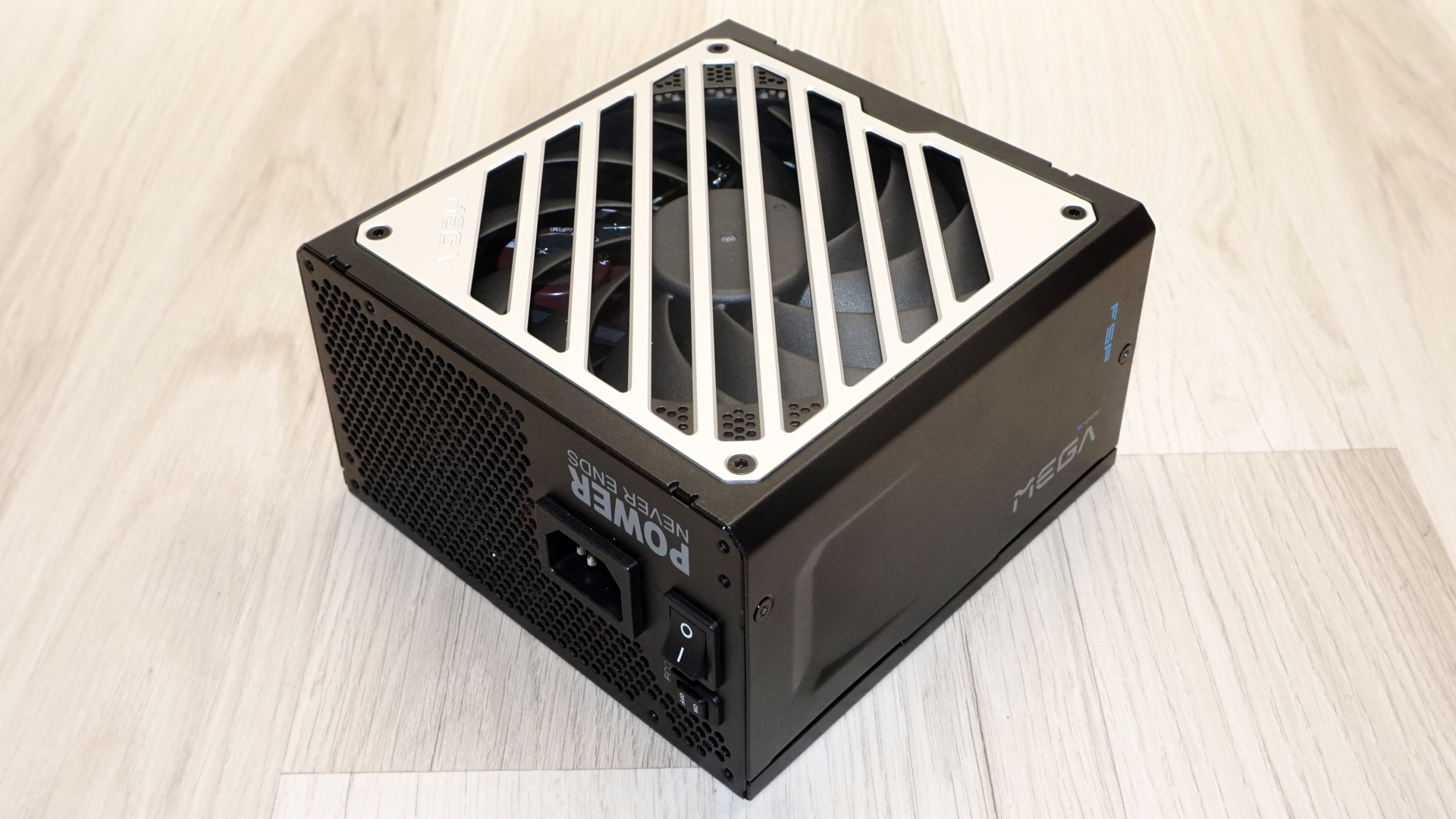
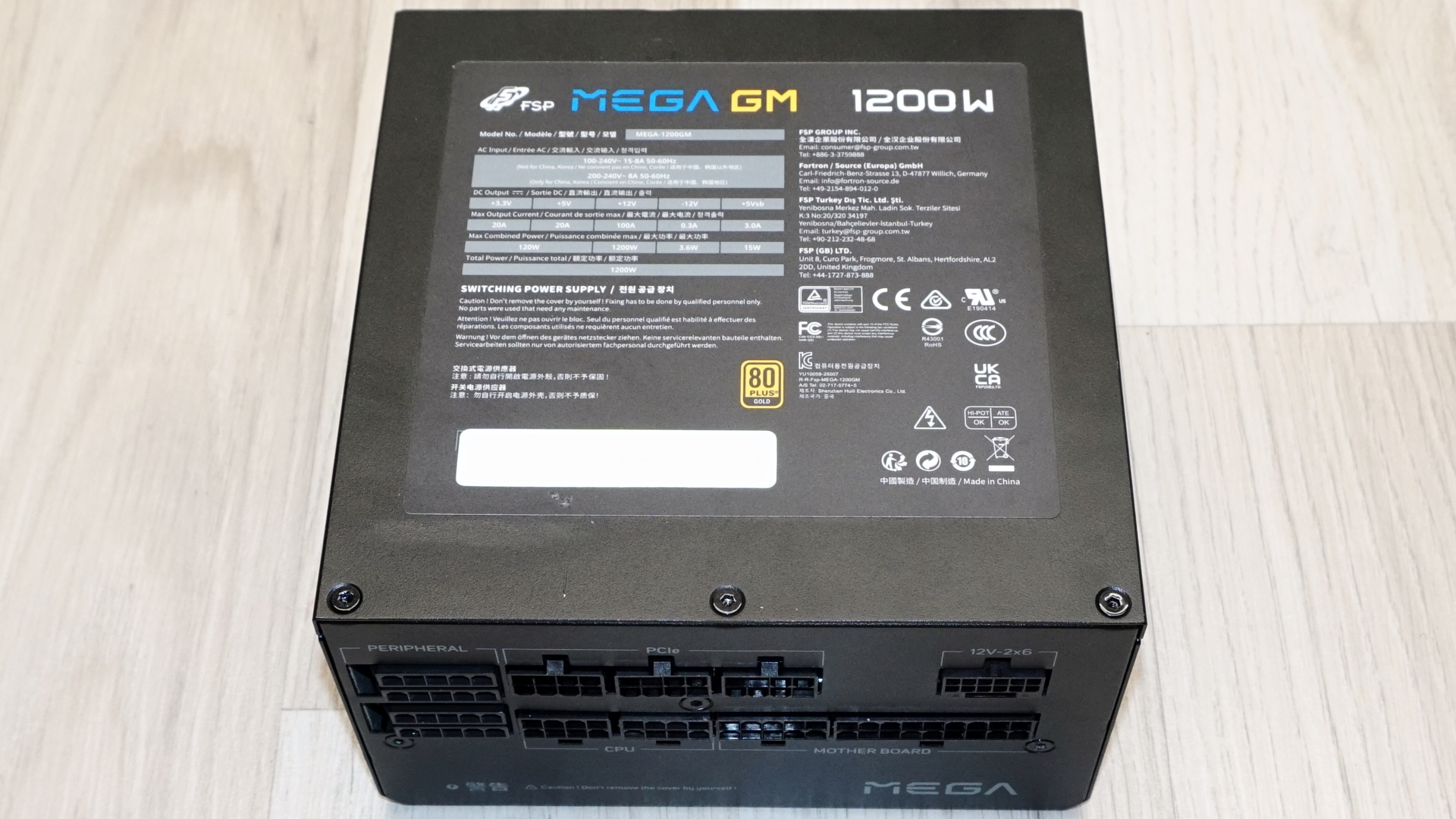
The top panel is given over to the intake fan, sitting behind a diagonally slatted finger guard finished in champagne-silver that lifts the otherwise monochrome look. At the sides of the unit, the “Mega” wordmark is picked out in one corner and the FSP logo resting above it. The full-length specification and certification label occupies the top side of the unit, the face that points upward in most installations. For the record, this sample is assembled in China, which is normal for FSP’s consumer lines despite the company’s Taiwanese roots.
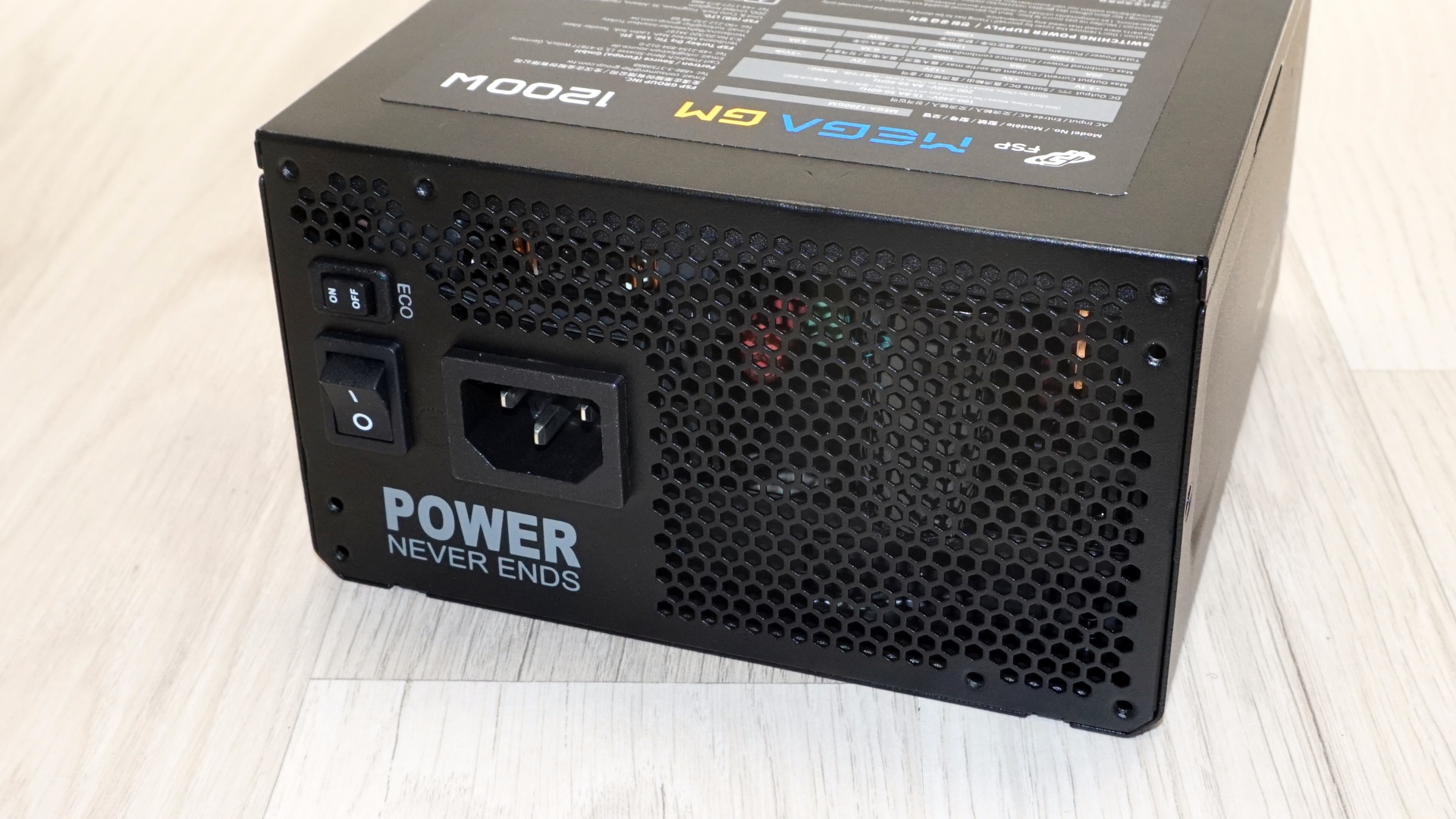
The mains side carries the AC receptacle and the primary rocker switch, joined by a separate ECO switch that enables or disables the semi-fanless mode — a welcome piece of user control rather than a fixed, non-negotiable profile for users that prefer the fan running at all times even if at a minimum speed. That same face is a large honeycomb exhaust grille, perforated edge to edge so the fan can push warm air straight out of the chassis. The opposite end houses the fully modular connector bay, with the sockets keyed so that plugging a cable into the wrong port during installation is effectively impossible.
Internal Design
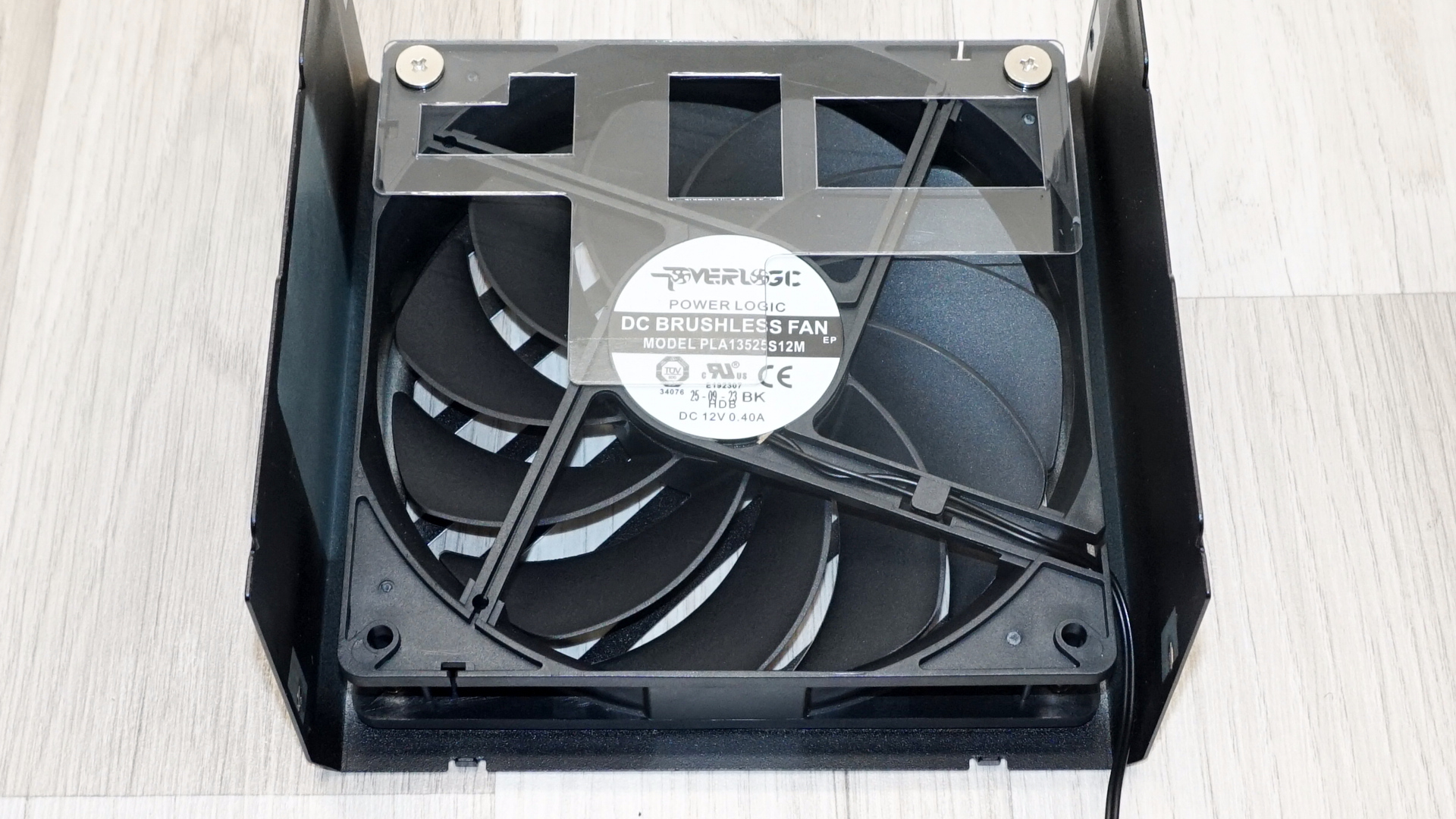
Cooling is handled by a 135 mm Power Logic PLA13525S12M, a fluid (hydro) dynamic bearing (FBD) fan drawing 0.40A at 12V. It is a known, well-regarded part. Τhe same model has turned up inside several other premium PSUs. An FBD is the right call at this tier, trading a little extra cost for low noise and a long service life.
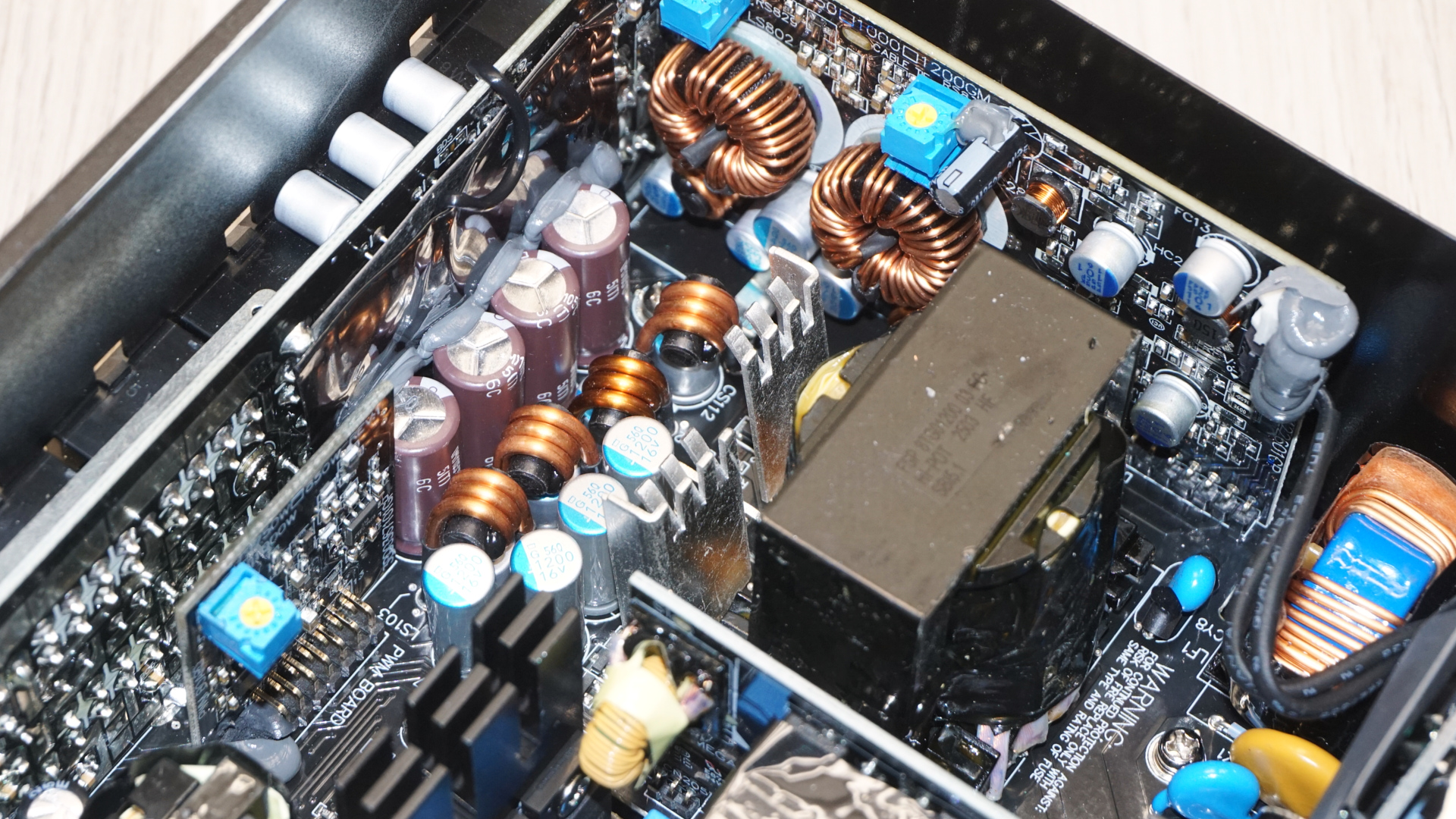
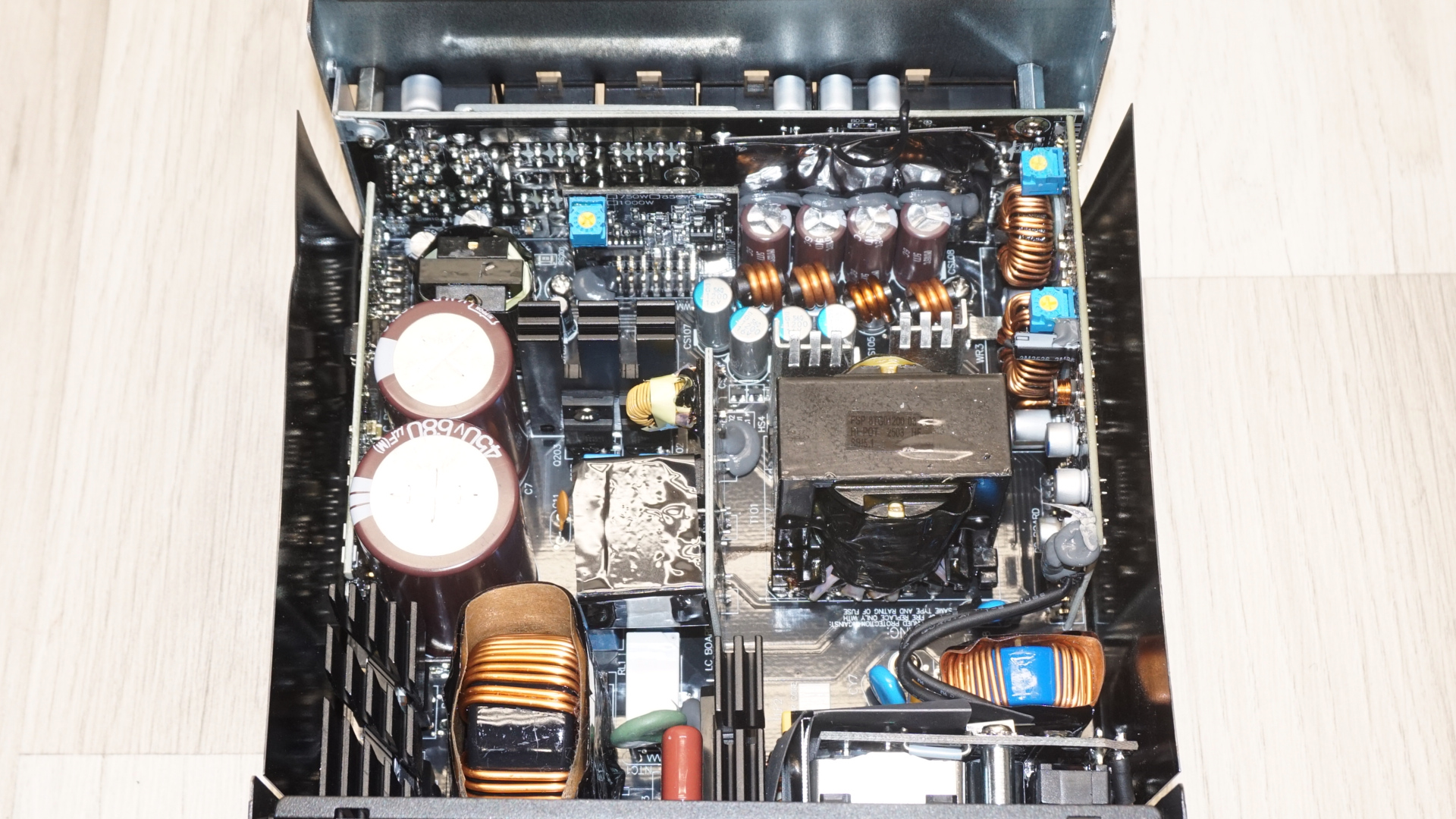
FSP both designs and builds the platform, so there is no hidden OEM behind it. The internals are tidy and logically laid out on a double-sided PCB. The transient filtering stage is good, with two Y capacitors, three X capacitors, two common-mode filtering inductors, and a single MOV. Mains rectification is handled by a pair of 600V bridges mounted on their own heatsink immediately after the filter.
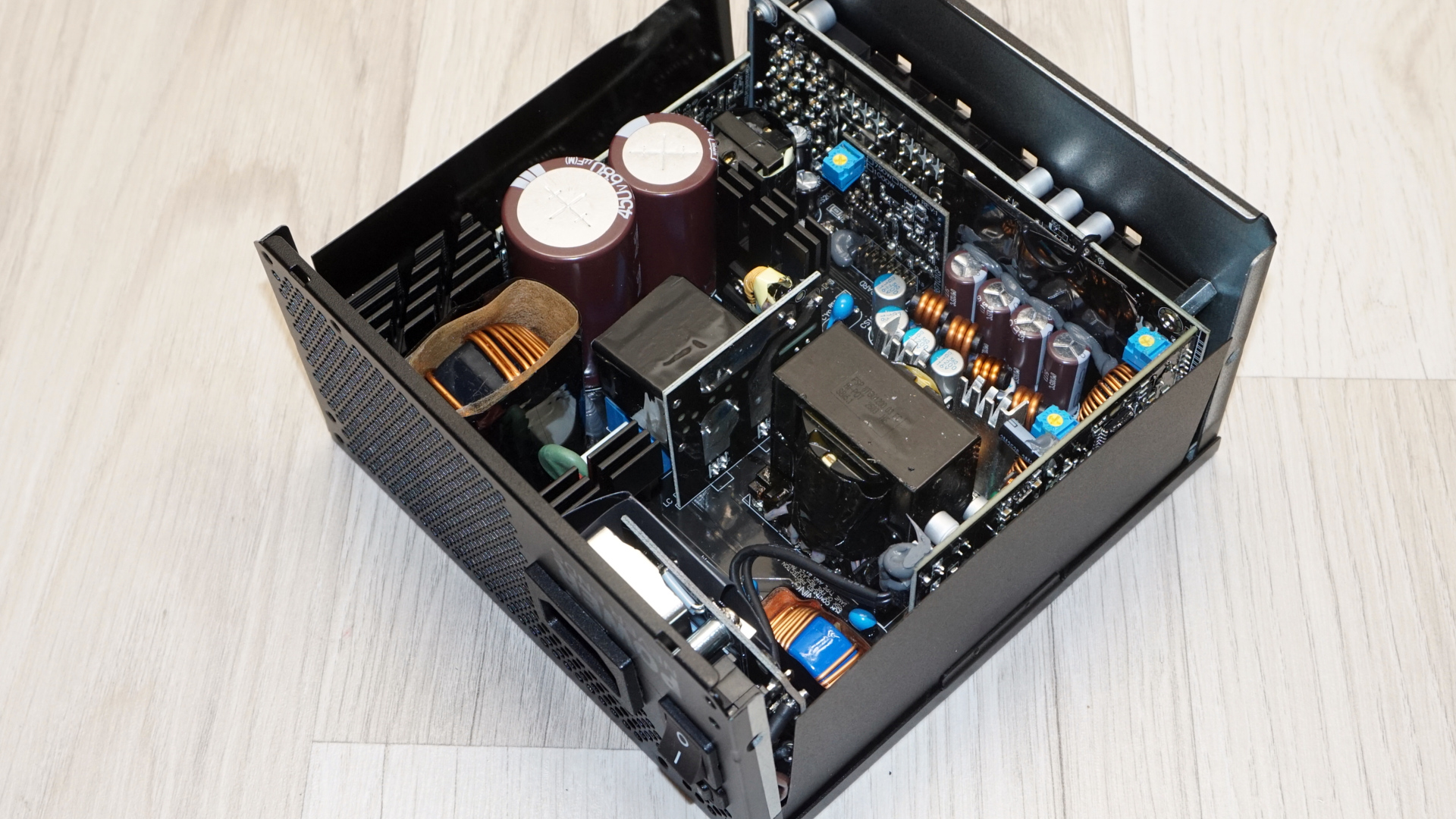
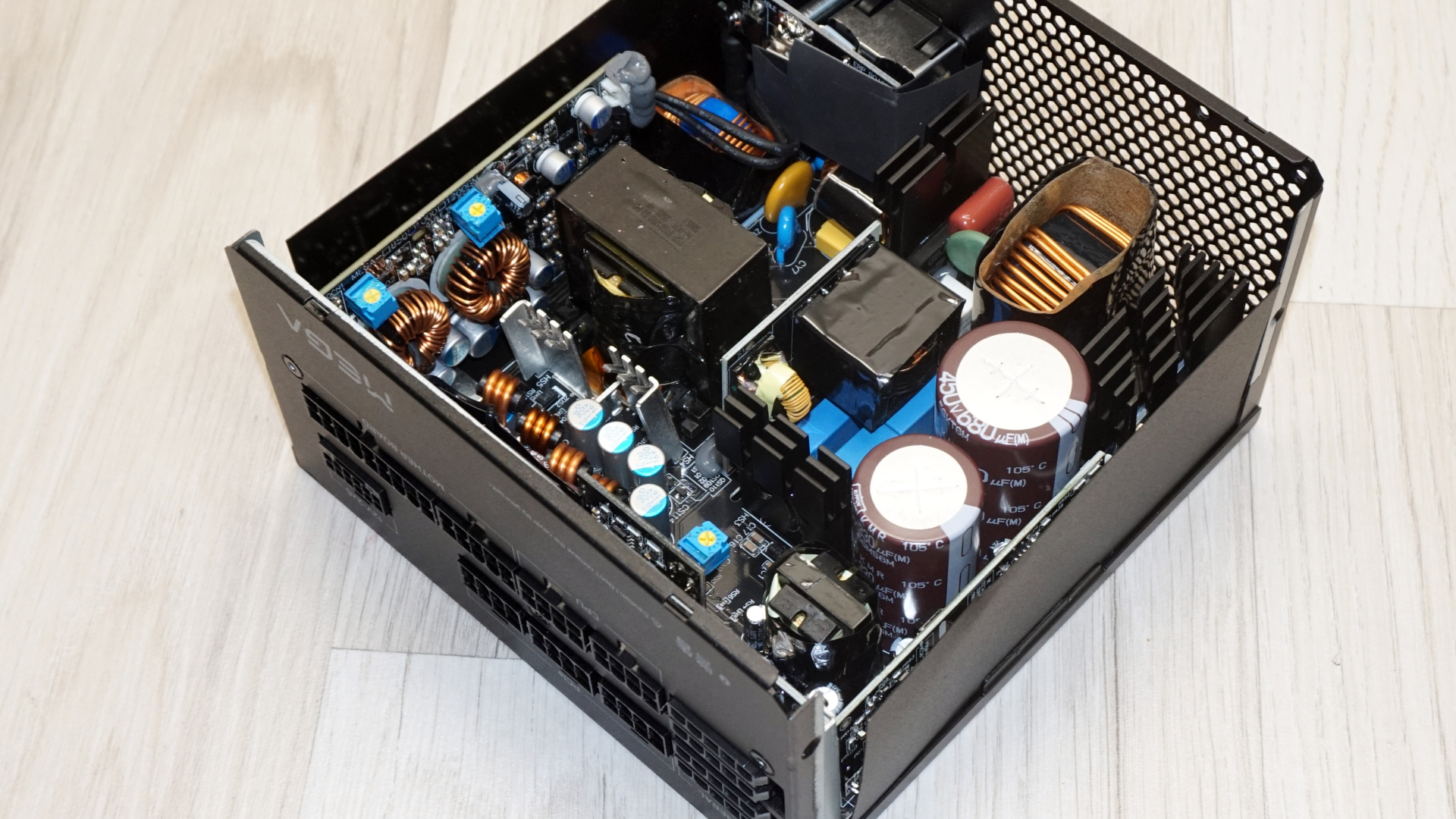
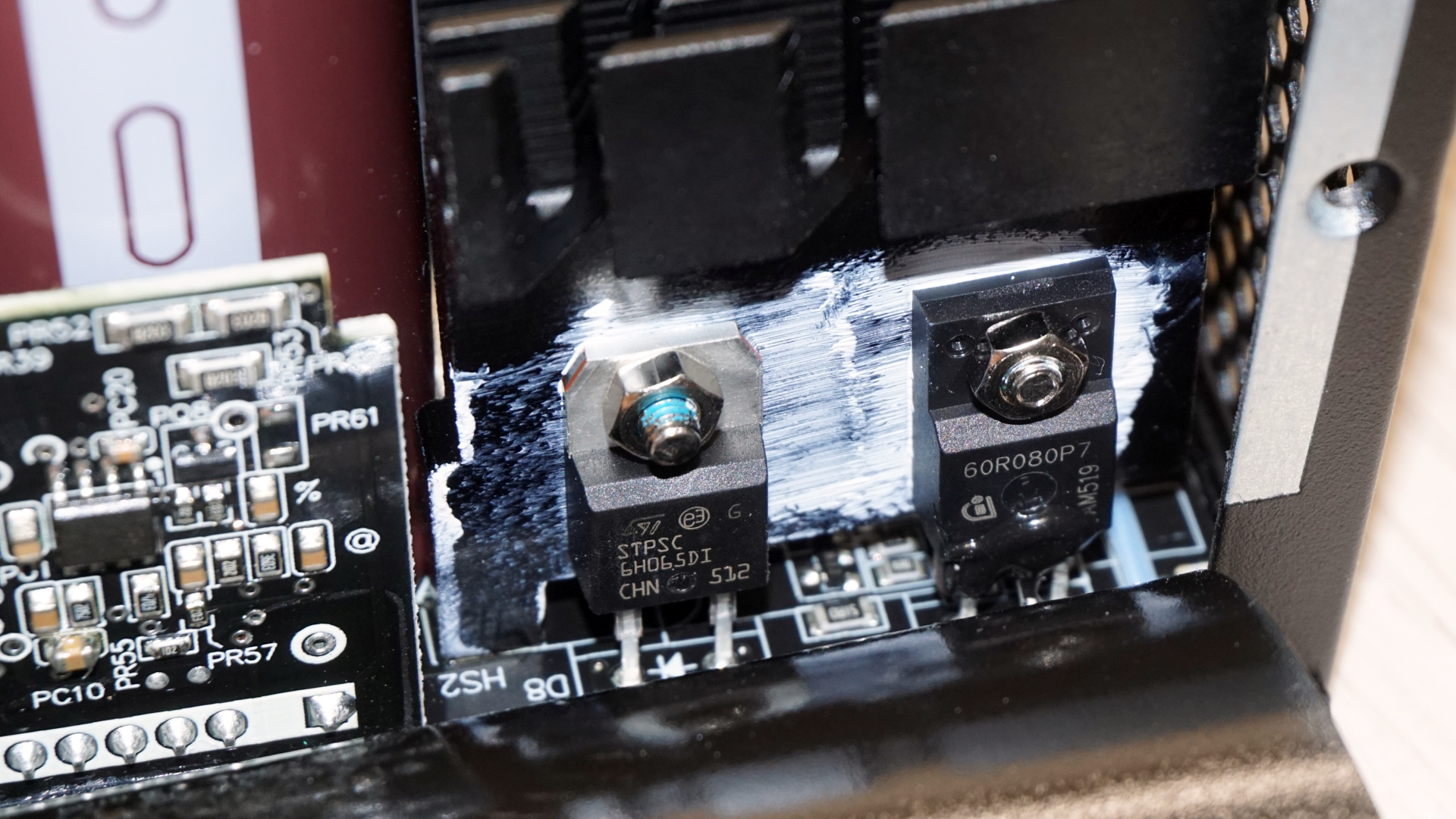
The active PFC stage pairs two Infineon 60R080P7 MOSFETs with two STMicroelectronics diodes found on their dedicated heatsink. Bulk energy storage is, pleasingly, entirely Japanese: two Nippon Chemi-Con 680 µF and 330 µF capacitors, both rated to 420V and 105 °C. The primary inversion stage uses two Greatpower GP47S60 MOSFETs arranged in a half-bridge LLC resonant topology, also found on their dedicated heatsink. This is a mature, reliability/cost-focused topology rather than the full-bridge arrangement reserved for top tier units. On the secondary side, the +12V rail is produced by synchronous rectification, with six Infineon 07N04LS6 MOSFETs doing the work. The minor 3.3V and 5V rails are derived from DC-to-DC converters.
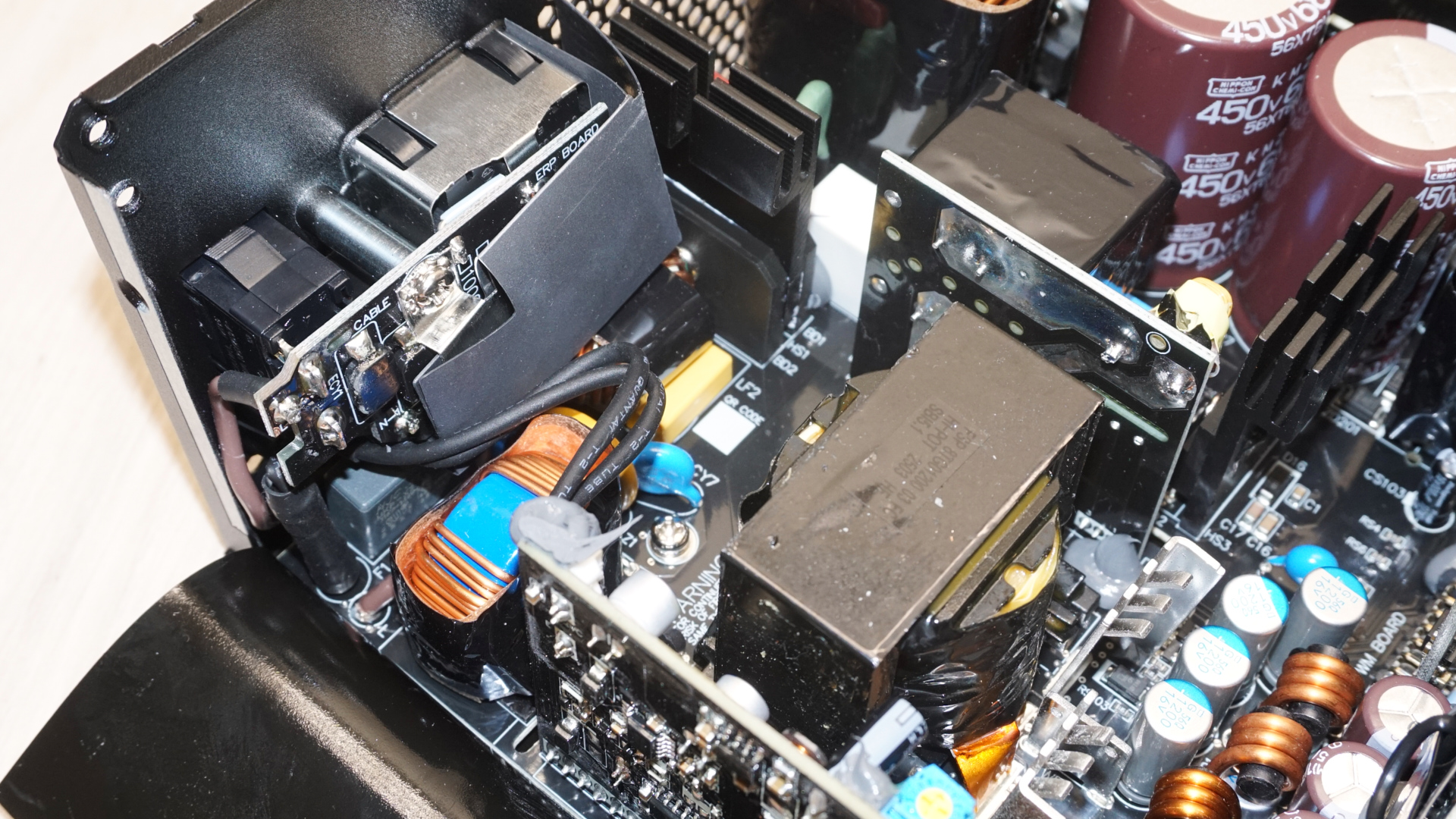
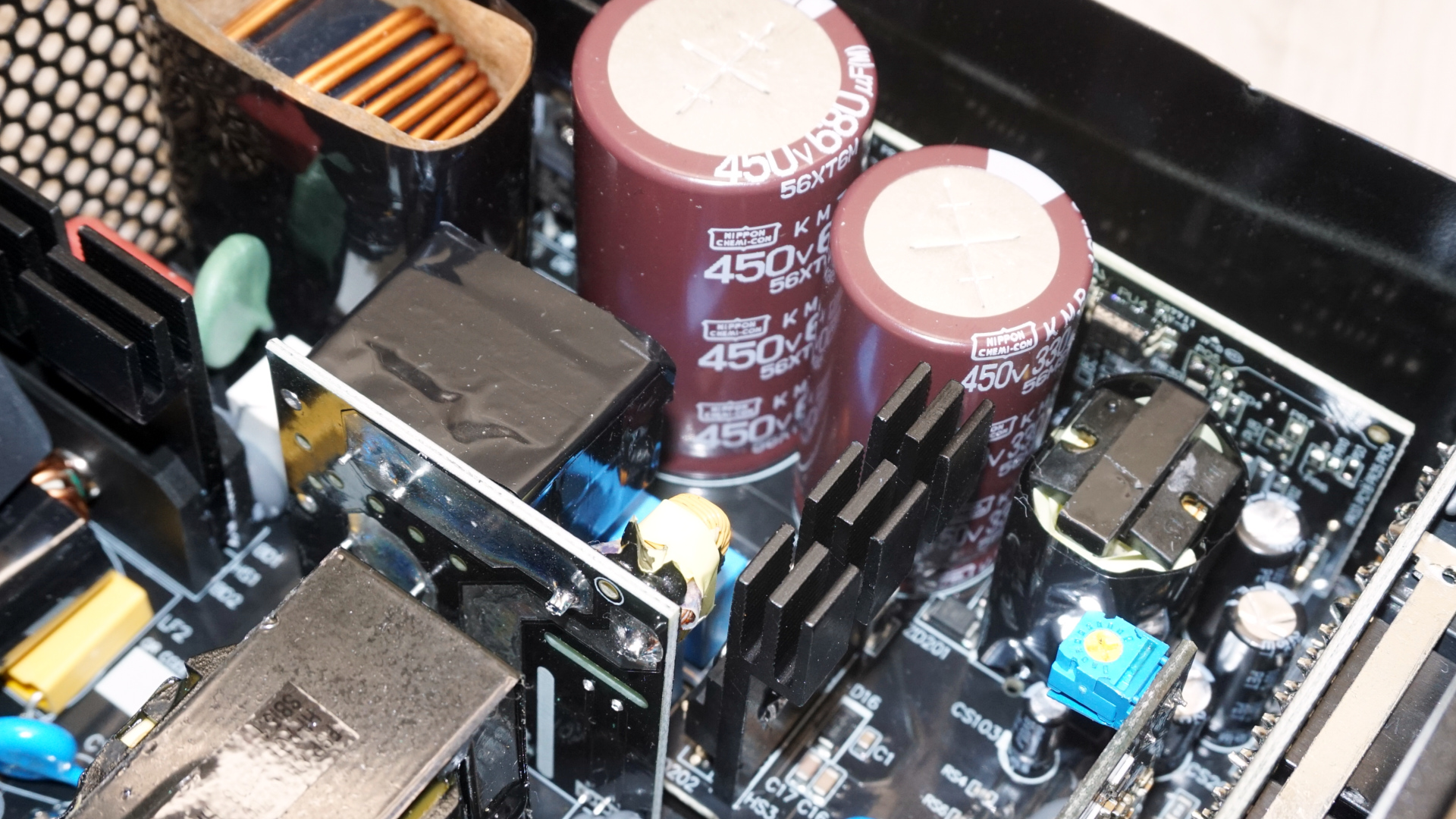
FSP has stayed disciplined with the secondary capacitors, which is the clearest single signal that the company is being serious regarding the marketing claims of this unit. The electrolytics are entirely Japanese, with all of the electrolytics supplied by Nippon Chemi-Con and Rubycon. The same goes for the solid-state capacitors, with Nippon Chemi-Con and Nichicon products handling high-frequency filtering. The one notable omission is dedicated fan-failure protection, which the unit does without.
Cold Test Results (25°C Ambient)
Cold Test Results (25°C Ambient)
For the testing of PSUs, we are using high-precision electronic loads with a maximum power draw of 2700 Watts, a Rigol DS5042M 40 MHz oscilloscope, an Extech 380803 power analyzer, two high-precision UNI-T UT-325 digital thermometers, an Extech HD600 SPL meter, a self-designed hotbox, and various other bits and parts.
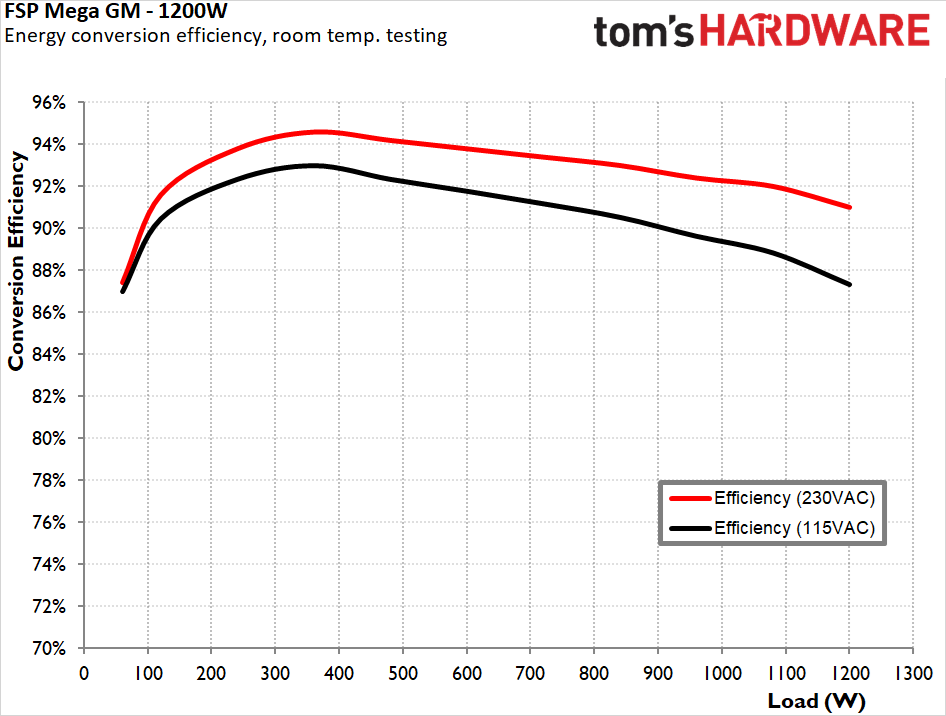
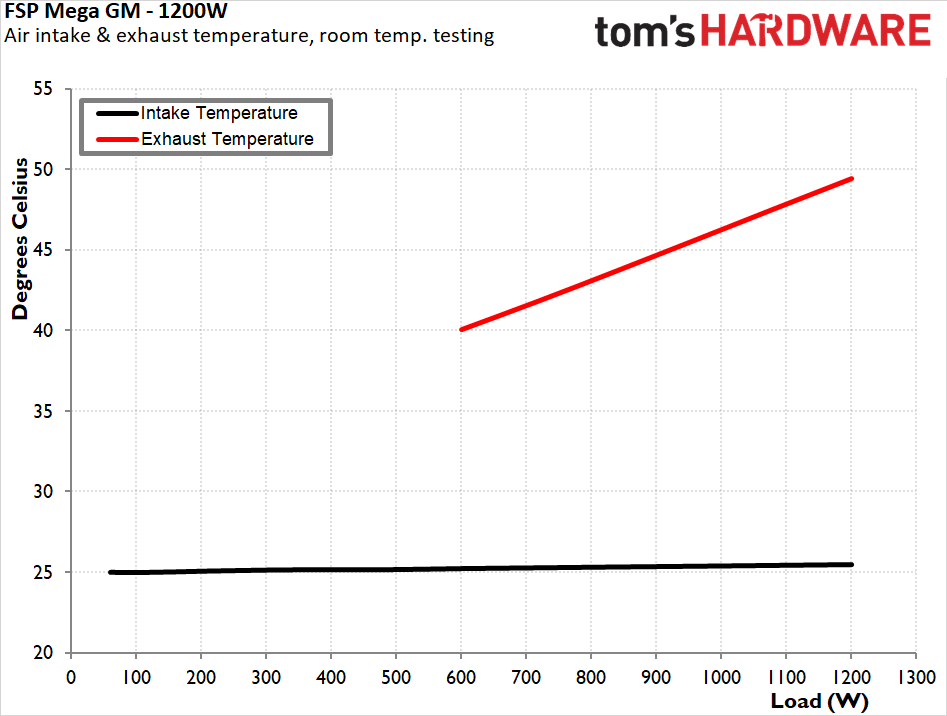
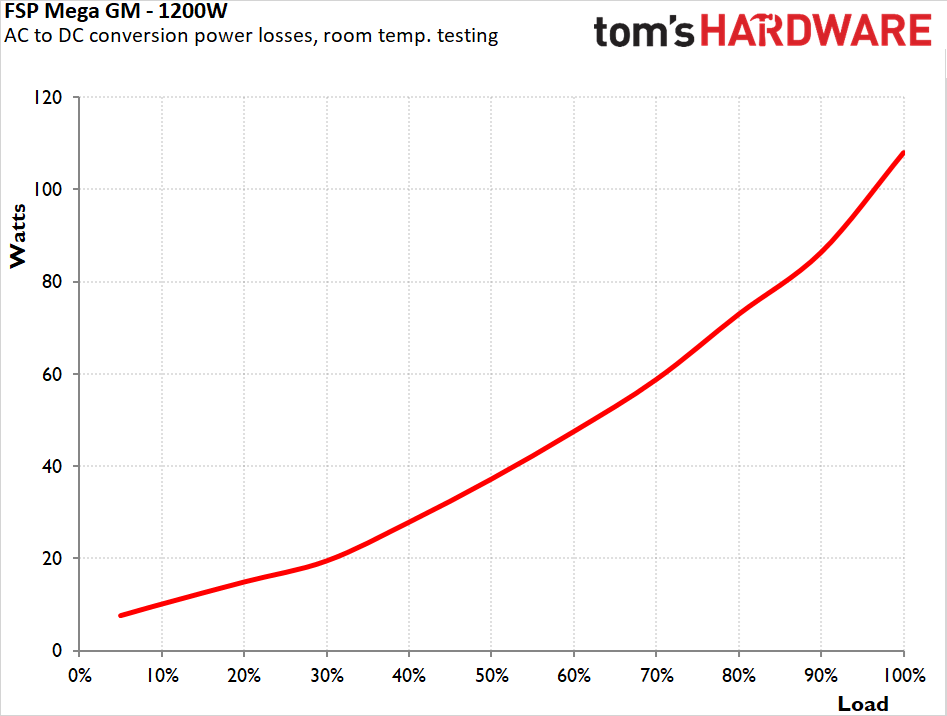
At 25 °C ambient, the Mega GM 1200W posts strong efficiency through the low and middle of its range. It averaged 93.0% at 230 VAC and 90.7% at 115 VAC across the nominal load band, peaking at roughly 94.6% near 30% load and holding above 92% across most of the curve. The weakness is at the top: efficiency sags as the unit approaches full output, dropping to 91.0% at 230 VAC and just 87.3% at 115 VAC at a sustained 1200W. That full-load dip has consequences for how the unit is rated. Despite the 80 PLUS Gold logo printed on the box, the Mega GM’s only independently verified efficiency credential is its Cybenetics certification — there is no corresponding entry in CLEAResult’s 80 PLUS database. The distinction is not academic: Cybenetics averages efficiency across the whole operating range, which is generous enough here to reach Platinum, whereas 80 PLUS tests fixed 20/50/100% load points with a strict full-load threshold. Under that methodology, the efficiency drop at maximum load is exactly what would cap the unit at Gold rather than Platinum. The headline efficiency is real, but it is flattered by the rating system it was measured under.
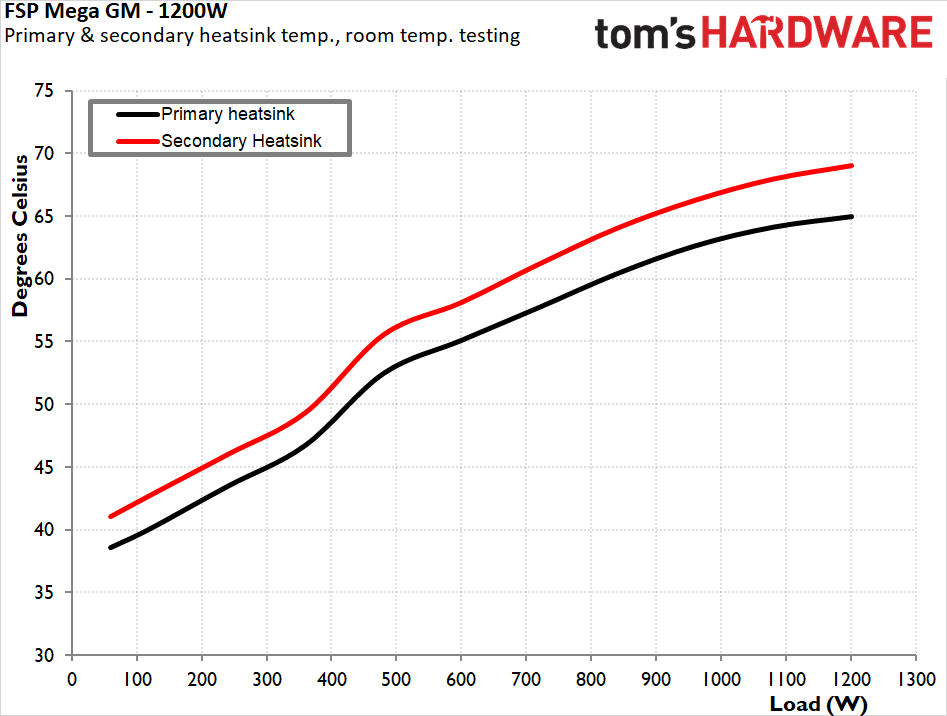
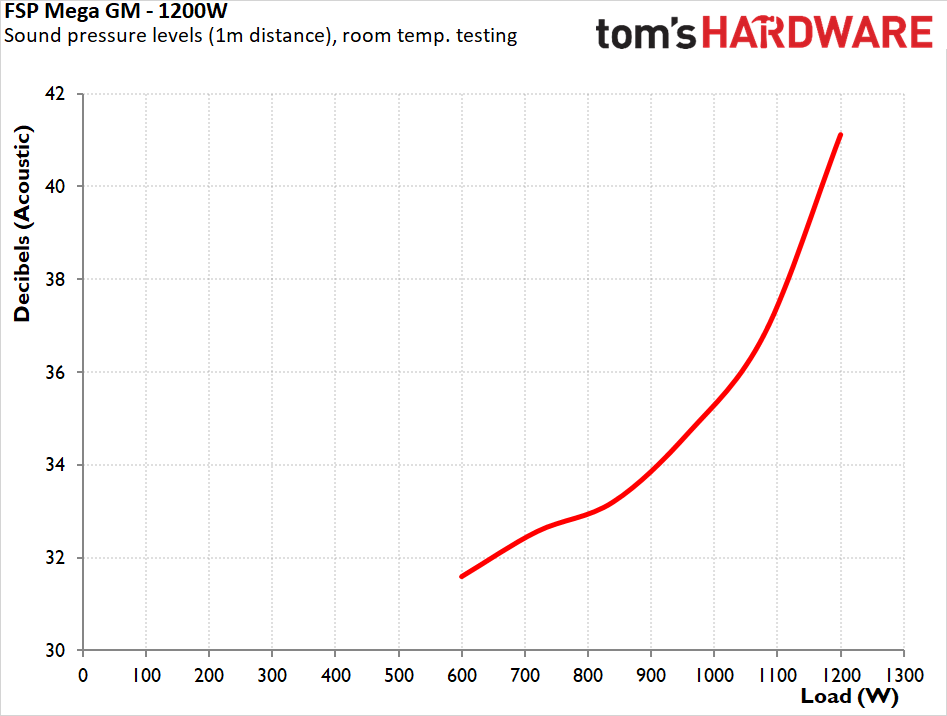
Acoustically, the cold run is where the rating earns its keep. With the ECO mode engaged, the fan simply stays off below roughly 50% load. Once it does spin up, it registers a barely-there 31.6 dB(A) at 600W, climbing gently to about 41 dB(A) only at the very top of the load range. For most real-world workloads, this supply is effectively inaudible. Internal temperatures stay well in hand throughout: the primary heatsink tops out near 65 °C and the secondary near 69 °C at full load.
Hot Test Results (~45°C Ambient)
Hot Test Results (~45°C Ambient)
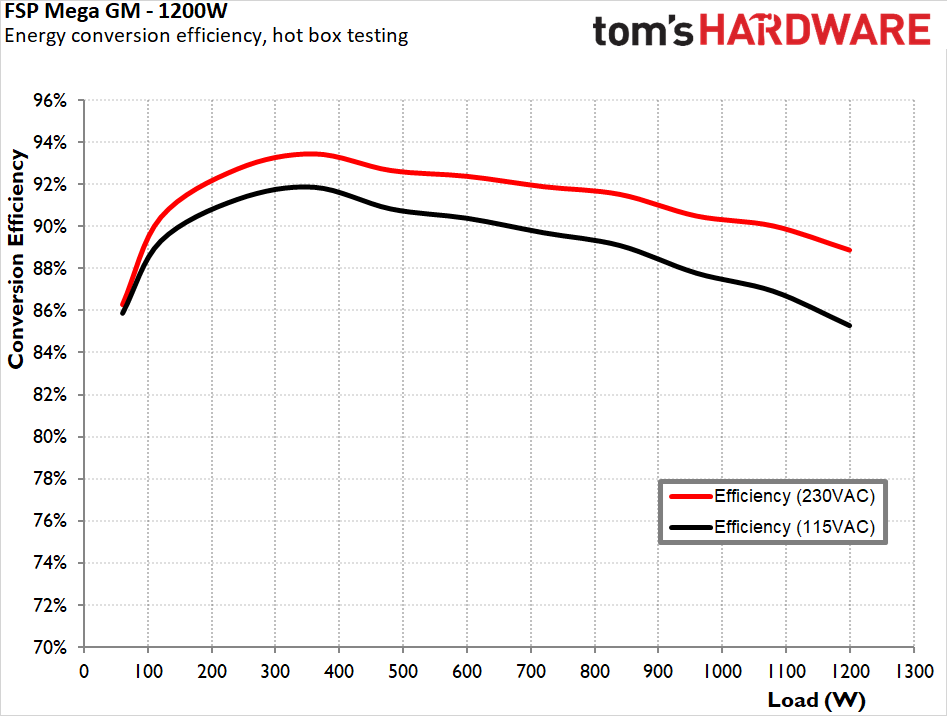
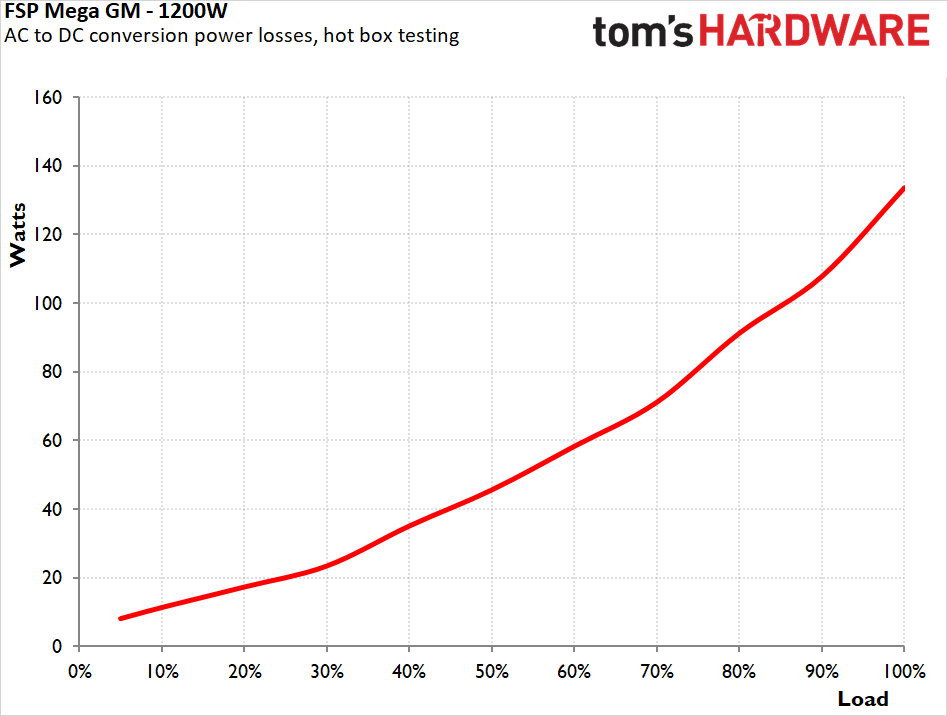
Raising the ambient to roughly 45 °C predictably trims efficiency, but not alarmingly. Average efficiency settles to 91.4% at 230 VAC and 89.2% at 115 VAC, with full-load figures of 88.9% and 85.3%, respectively. The drop of around 1.6 points at 230 VAC is measurable but normal for the temperature delta, and at no load point did the unit show any hint of thermal instability or output stress during sustained running.
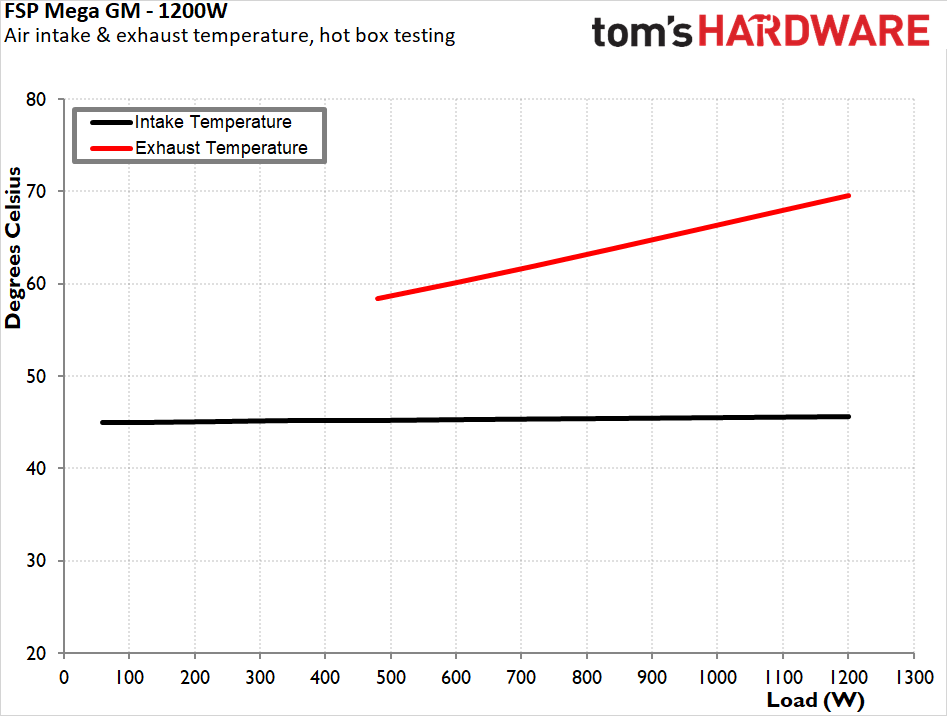
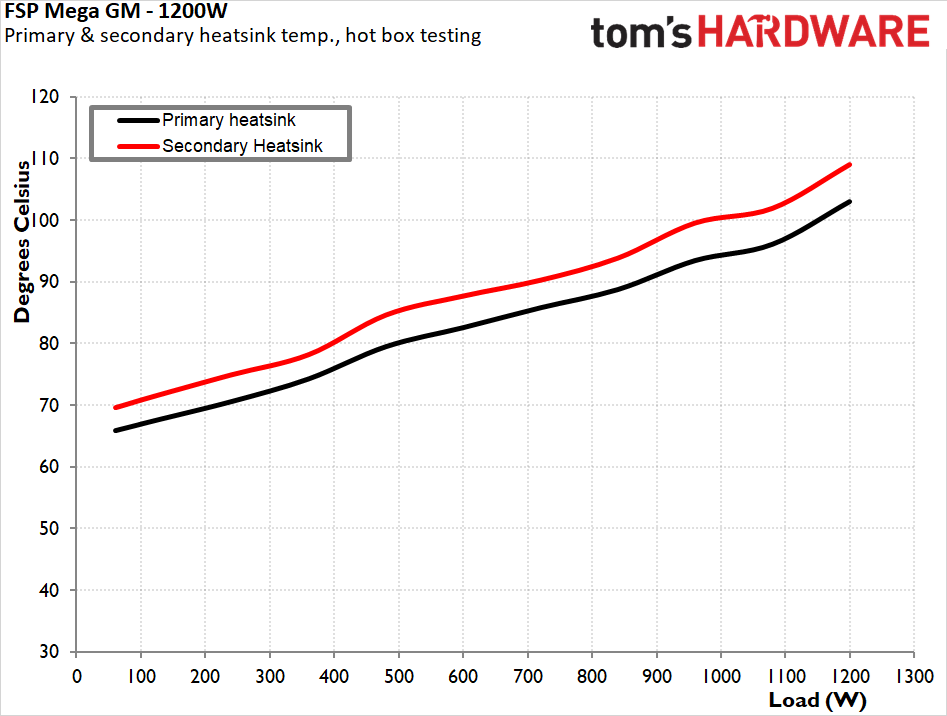
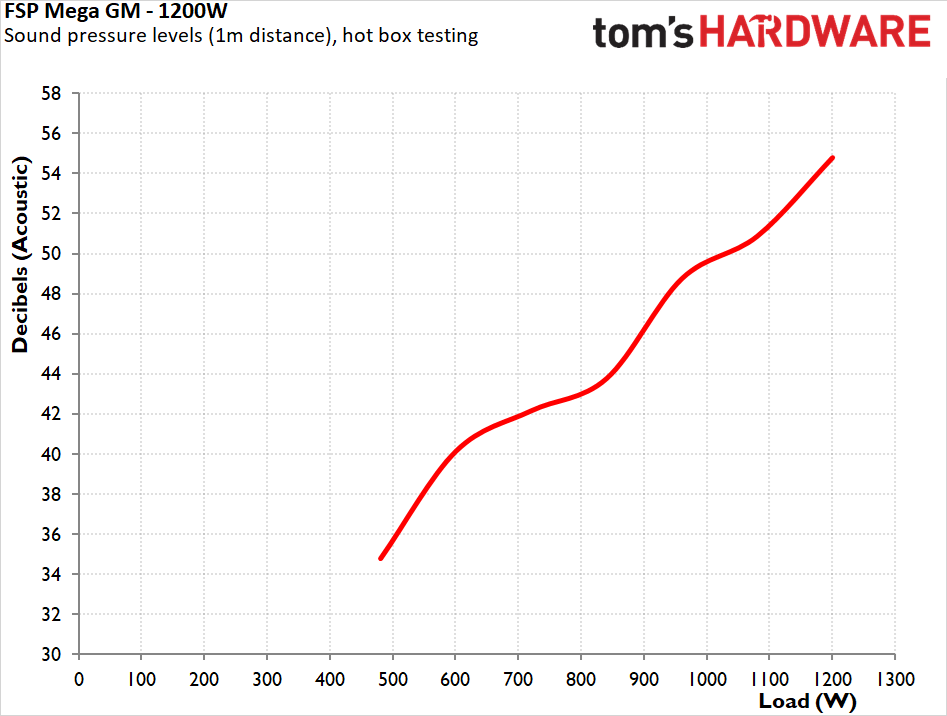
Noise is the one area where the heat clearly changes the character of the unit. The fan engages earlier and ramps harder, rising from the low-30s dB(A) through the mid-load range to about 55.0 dB(A) at a sustained 1200W. That is a substantial step up from the cold run and the loudest this supply gets — though it is worth keeping in perspective that it only happens at the intersection of maximum load and elevated ambient, a corner most systems should never visit. Internal temperatures rise accordingly, with the secondary heatsink reaching roughly 109 °C and exhaust air near 70 °C at full load, figures that are flirting with the OTP protection, but the platform held composure for the duration of testing.
PSU Quality and Bottom Line
Power Supply Quality
Voltage regulation is solid without being a strong point. Across the 20% to 100% load span, the 12V rail moved by 1.2%, the 5V rail by 1.5%, and the 3.3V rail by 1.3%. FSP markets its MTLC scheme as delivering ±1% regulation, but only the 12V rail comes close to that figure. The minor rails clearly miss it, with the 5V line in particular drifting half a point beyond the claim. It is a perfectly acceptable result for a 1200W unit, just not the precision the marketing implies.
Ripple suppression is another weak point. The unit stays very well inside the ATX limits, but it is some way off class-leading. The 12V rail peaked at 44 mV under full load and 46 mV under the harsher cross-load condition, with the 5V rail at 28 mV and the 3.3V rail at 26 mV. Against the 120 mV (12V) and 50 mV (3.3V/5V) ATX ceilings, that is a comfortable pass, yet the best units in this price bracket hold the filtering tighter. For a supply that does so well on efficiency and noise, the ripple figures are a conspicuous step down.
During our thorough assessment, we evaluate the essential protection features of every power supply unit we review, including Over Current Protection (OCP), Over Voltage Protection (OVP), Over Power Protection (OPP), and Short Circuit Protection (SCP).
All protection mechanisms, including OCP, OVP, OPP, and SCP, were verified and triggered correctly during testing. The OCP tripped at 126% on the 3.3V rail, 128% on the 5V rail, and 120% on the 12V rail, with OPP engaging only at roughly 120% of rated output before shutdown. The protection circuitry is on the conservative side, favoring equipment reliability.
Load (Watts) | 242.42 W | 603.12 W | 901.88 W | 1197.63 W | ||||
Load (Percent) | 20.20% | 50.26% | 75.16% | 99.80% | ||||
Amperes | Volts | Amperes | Volts | Amperes | Volts | Amperes | Volts | |
3.3 V | 1.87 | 3.37 | 4.68 | 3.36 | 7.01 | 3.34 | 9.35 | 3.33 |
5 V | 1.87 | 5.10 | 4.68 | 5.09 | 7.01 | 5.03 | 9.35 | 5.02 |
12 V | 18.71 | 12.11 | 46.77 | 12.05 | 70.15 | 12.02 | 93.53 | 11.97 |
Line | Regulation | Voltage Ripple (mV) | |||||
(20% to 100% load) | 20% Load | 50% Load | 75% Load | 100% Load | CL1 | CL2 | |
3.3V | 1.3% | 20 | 16 | 18 | 26 | 20 | 26 |
5V | 1.5% | 22 | 18 | 24 | 28 | 18 | 26 |
12V | 1.2% | 22 | 28 | 32 | 44 | 46 | 24 |
Bottom Line
Specifications aside, the Mega GM 1200W is a very capable power supply that falls just short of the top tier on a handful of specific, identifiable points. FSP designs and builds the platform itself, which is worth more than it sounds, as this is not a rebadged contract design but an in-house effort from one of the largest and oldest power-supply manufacturers in the world, and the engineering discipline shows in the layout, the soldering quality, and the parts selection. The bones of this unit are excellent.
The build is where it is least open to criticism. The capacitor complement is 100% Japanese on both the primary and secondary sides, while the active components also are top-tier, a choice that speaks to longevity rather than to a cost target. The 150 mm chassis is genuinely compact for 1200W and drops into mid-tower cases that many rivals of this output simply will not fit. The ten-year warranty is the kind of commitment that, in this segment, tracks platform quality more reliably than almost any single number on the box.
Efficiency is where the marketing and the measurements part ways, and it deserves to be spelled out for prospective buyers, even if the marketing actually undersells the unit. The low and middle of the load range the unit is excellent but it sags at full load, and that has a concrete consequence. The Mega GM officially carries only a Cybenetics certification — there is no 80 PLUS listing from CLEAResult behind the Gold logo on the box. Cybenetics’ whole-range averaging is forgiving enough to award Platinum, but under 80 PLUS’s fixed-load-point testing that full-load dip would probably pull the unit down to Gold. Anyone shopping on the strength of a Platinum efficiency figure should understand that the number depends entirely on which methodology you trust, or the kind of use you are going to put the Mega GM to.
The electrical results reinforce the impression of a unit that is good rather than outstanding. Ripple suppression is always within spec, but the figures are noticeably higher than what the best units in this bracket achieve. Load regulation is acceptable yet misses FSP’s own ±1% MTLC claim on the minor rails, with the 5V line the clear laggard. The protections all work, though their thresholds prioritize conservative shutdown. None of these is a deal-breaker on its own; collectively, they are the difference between a strong unit and a class-leading one, and they are why this review stops short of a higher score.
Availability is the last thing to weigh, and it is sharply regional. Across Europe and Asia, the Mega GM 1200W is available but, even then, not readily. At an MSRP of $229 and significantly lower retail pricing, the unit is sensibly priced for what it delivers, which makes it an easy unit to recommend to readers in those markets. In the United States, by contrast, stock is currently very hard to come by, even though the manufacturer assures us that the unit will eventually become available. Taken as a whole, this is an FSP-built, all-Japanese, compact 1200W supply with excellent acoustics and strong everyday efficiency. It earns a solid recommendation in the regions where you can actually buy it - just not an unqualified one.
MORE: Best Power Supplies
MORE: How We Test Power Supplies
MORE: All Power Supply Content