The complexity of modern electronic systems is growing faster than traditional engineering workflows can efficiently manage. High-speed interfaces, dense PCB layouts, advanced packaging technologies, and increasingly stringent performance requirements are forcing organizations to rethink how design decisions are made, validated, and optimized.
This challenge is driving the adoption of intelligent engineering methodologies built upon three interconnected capabilities: optimization, automation, and artificial intelligence (AI). Optimization improves decision quality through systematic exploration of design alternatives. Automation enables those decisions to be executed consistently and efficiently at scale. AI introduces the ability to interpret results, identify patterns, and assist engineers in making informed decisions.
The growing complexity challenge
Modern electronic systems are expected to deliver more performance, more connectivity, and greater efficiency than ever before. Interfaces such as DDR, PCIe, Ethernet, and other high-speed SerDes technologies continue to increase data rates while simultaneously reducing available design margins. At the same time, development schedules continue to shrink.
Engineering teams are no longer designing isolated circuits. They are designing highly interconnected systems where signal integrity, power integrity, thermal behavior, electromagnetic effects, and manufacturing constraints interact in ways that are increasingly difficult to predict through experience alone.
Traditional workflows remain heavily dependent upon a cycle of simulation, analysis, design modification, and revalidation. While this methodology has served the industry well, its scalability is being challenged by the sheer number of variables involved in modern designs.
The result is an industry-wide shift toward more intelligent systems that help engineers manage complexity without sacrificing accuracy or innovation.
dBRICK as a representative design challenge
The dBRICK design provides a useful example of the challenges facing modern electronic design teams. Originally developed as part of the European dRedBox initiative, dBRICK incorporates many characteristics common to contemporary high-performance systems. The design contains multiple PCIe Gen3 channels, high-density FPGA interfaces, complex differential routing structures, numerous vias and breakout regions, and multiple power delivery networks that must all operate together reliably.

Fig. 1: Layout view of dBRICK add-in card.
While the specific application may differ from a networking appliance, industrial controller, aerospace platform, or data center accelerator, the engineering challenges are similar.
Designers must answer questions such as:
- How should differential pairs be routed to maintain signal integrity?
- Which via structures provide the best electrical performance?
- How should power delivery networks be optimized?
- Which design variables have the greatest influence on performance?
- How quickly can validation be completed within the development schedule?
The answers are not always obvious because many design variables interact simultaneously. A modification that improves insertion loss may negatively impact impedance. A change that improves return loss may complicate manufacturing. Additional decoupling capacitors may improve power delivery while increasing cost and routing congestion.
This reality forms the foundation for understanding the roles of optimization, automation, and AI.
Optimization: Managing an expanding design space
Historically, engineers relied heavily on experience, design guidelines, and targeted simulations to identify acceptable solutions. As systems have grown more complex, this approach has become increasingly difficult to scale.
The challenge is no longer finding a design that works. The challenge is finding the best design among thousands of possibilities.
Consider a PCIe differential pair within the dBRICK design. Performance may be influenced by:
- Trace width
- Trace separation
- Dielectric thickness
- Layer transitions
- Via geometry
- Pad dimensions
- Anti-pad dimensions
- Connector characteristics
Each variable affects performance, and many of them interact with one another in non-linear ways. Changing trace width, for example, may improve insertion loss but also alter differential impedance. Adjusting via dimensions may improve one frequency range while degrading another. Small changes often produce effects that are difficult to predict through intuition alone.
This highlights one of the central challenges of modern engineering: human judgment remains valuable, but human intuition becomes less effective as the number of interacting variables increases.
Optimization addresses this challenge through systematic exploration of the design space. Instead of evaluating a handful of configurations, engineering teams can examine hundreds or thousands of possible combinations while measuring their effect on performance objectives. This allows designers to identify sensitivities, understand tradeoffs, and discover solution regions that might otherwise remain hidden. The same concept applies to power delivery networks.
Optimization techniques allow engineers to determine whether a design is truly under-engineered, appropriately engineered, or over-engineered. Optimization therefore represents much more than a simulation tool. It is a methodology for transforming engineering decisions from educated guesses into data-driven choices.

Fig. 2: Rising edge waveform results from swept parameter analysis.
Automation: Scaling engineering expertise
While optimization improves decision quality, it does not solve another growing challenge: execution. Engineering organizations today perform more simulations than ever before.
Every design revision must be validated. Every critical interface must be analyzed. Every power rail must be evaluated. As products become more sophisticated, analysis workloads increase dramatically.
Consider a design containing dozens of high-speed channels. Simulations may need to be repeated across multiple design revisions, operating conditions, and manufacturing tolerances. Even when individual analyses are relatively straightforward, the total workload can become overwhelming. The bottleneck is often not computational power; the bottleneck is engineering time.
Another challenge involves the scalability of expertise. Many organizations possess highly experienced signal and power integrity specialists whose knowledge has been accumulated over decades. However, that expertise is often difficult to replicate across larger teams.
Two engineers performing the same task may:
- Use different assumptions
- Select different software settings
- Apply different validation criteria
- Interpret requirements differently
This introduces inconsistency into the engineering process.
As design complexity increases, so does the risk of human error. Incorrect model assignments, incomplete setup procedures, overlooked validation steps, and inconsistent reporting can all create costly delays. Automation addresses these challenges by embedding knowledge within repeatable workflows.
Rather than requiring engineers to manually configure every step of an analysis, automation ensures that critical procedures are executed consistently. Simulations can be launched in batches, results can be collected automatically, and validation processes can be standardized across projects and teams.
The value extends beyond productivity. Automation improves repeatability, reduces process variation, and enables engineering organizations to scale expertise more effectively. Best practices become part of the workflow rather than remaining dependent upon individual users.
Ultimately, automation allows engineers to spend less time managing processes and more time solving engineering problems.
AI: Transforming data into insight
If optimization helps engineers explore design possibilities and automation helps them execute workflows, AI addresses a different challenge entirely: understanding results.
Modern engineering tools generate enormous quantities of data. A single design may produce:
- Eye diagrams
- Jitter measurements
- S-parameters
- Insertion loss curves
- Return loss plots
- Compliance reports
- Power integrity analyses
- Electromagnetic simulation results
The problem facing many organizations is no longer data scarcity. It is information overload.
In the dBRICK example, engineers evaluating PCIe channels may generate dozens of reports for a single interface. Across an entire design, the volume of engineering data can quickly become overwhelming. Understanding what the results mean is considerably more difficult.
Many industries are experiencing shortages of highly specialized signal and power integrity experts, while simultaneously confronting increasingly sophisticated designs. As senior engineers retire and development complexity continues to grow, organizations face an expanding knowledge gap.
Perhaps the most difficult task in engineering is root-cause analysis. Determining that a design has failed is often relatively simple; determining why it failed is considerably harder.
A degraded eye pattern might originate from excessive channel loss, impedance discontinuities, crosstalk, poor power delivery, connector transitions, or some combination of these factors. Identifying the true source often requires extensive investigation.
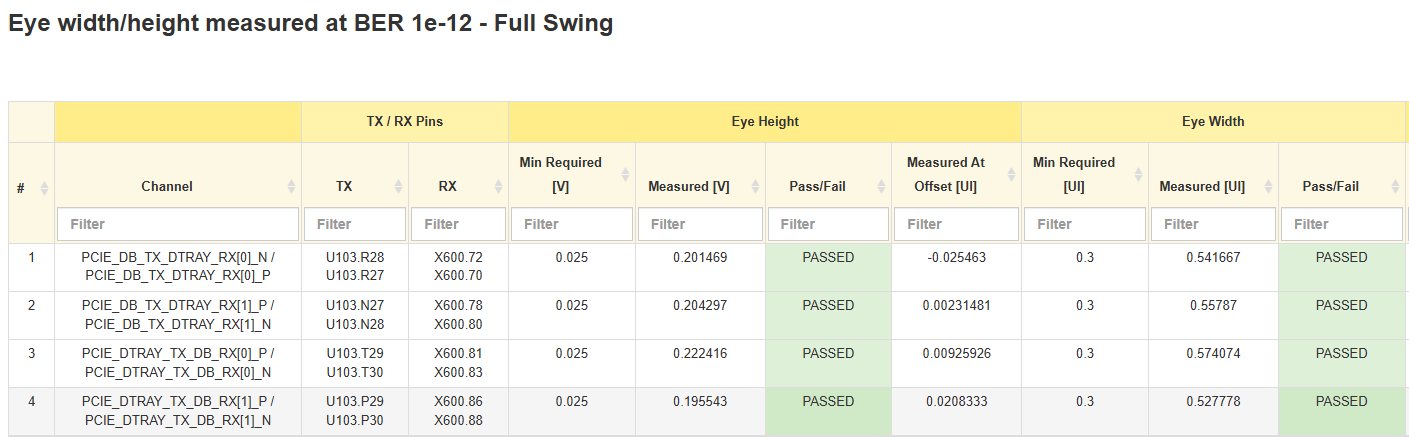
Fig. 3: HTML results generated from SerDes Compliance Wizard showing eye height and width metrics.
This is where AI has the potential to create substantial value. AI systems can help engineers navigate complexity by transforming large volumes of technical data into actionable insights.
In practical terms, AI may serve several roles:
- As a teacher, it can help users understand workflows and best practices.
- As an assistant, it can guide engineers through complex setup procedures.
- As an analyst, it can review simulation results and highlight potential concerns.
- As an advisor, it can help identify likely root causes and suggest areas for further investigation.
Within the dBRICK example, an AI-enabled workflow could examine PCIe compliance results and identify which portions of the channel contribute most significantly to signal degradation. Rather than spending hours investigating dozens of potential causes, engineers could focus immediately on the most likely contributors.
Putting intelligent engineering into practice
Many of these concepts are already being implemented within commercial engineering environments.
Siemens EDA’s HyperLynx platform provides examples of optimization capabilities through swept parameter analysis, power delivery network optimization, and multidimensional design space exploration. These technologies help engineers evaluate complex relationships between design variables and identify high-performing solutions.
The platform also incorporates numerous automation capabilities. Guided compliance workflows, protocol-aware analysis environments, scripting interfaces, and scalable execution frameworks reduce manual effort while improving consistency and repeatability across projects.
Emerging AI-driven functionality represents the next stage of this progression. Natural-language assistants can help users navigate workflows and access product knowledge more efficiently. AI-based analysis technologies are also being developed to help engineers interpret simulation results, identify potential issues, and accelerate root-cause investigation.

Fig. 4: Copilot used in HyperLynx DRC to run rules on dBRICK.
Taken together, these capabilities illustrate how the industry is moving beyond isolated simulations toward connected workflows that combine optimization, automation, and AI into a unified engineering process.
Conclusion
The growing complexity of modern electronic systems is forcing organizations to rethink traditional engineering methodologies. As design spaces expand, analysis workloads increase, and technical data volumes continue to grow, optimization, automation, and AI are becoming essential capabilities rather than optional enhancements.
Optimization enables engineers to make better decisions. Automation enables those decisions to be executed efficiently and consistently. AI enables engineers to transform data into actionable insight.
These technologies are not competing approaches. They are complementary layers of an emerging intelligent engineering framework.
Organizations that successfully integrate these capabilities into their development processes will be better equipped to manage complexity, accelerate innovation, improve product quality, and meet the demands of next-generation electronic systems.
The evolution toward intelligent engineering is already underway. The question facing most organizations is no longer whether optimization, automation, and AI will become part of engineering workflows, but how quickly they can be leveraged to create meaningful competitive advantage.
For a fuller analysis of how HyperLynx can support your team with optimization, automation, and AI, please read the new paper from Siemens, The evolution of intelligent systems: From optimization to automation to AI.
The post Intelligent Engineering: From Optimization To AI appeared first on Semiconductor Engineering.